CC ATLAS
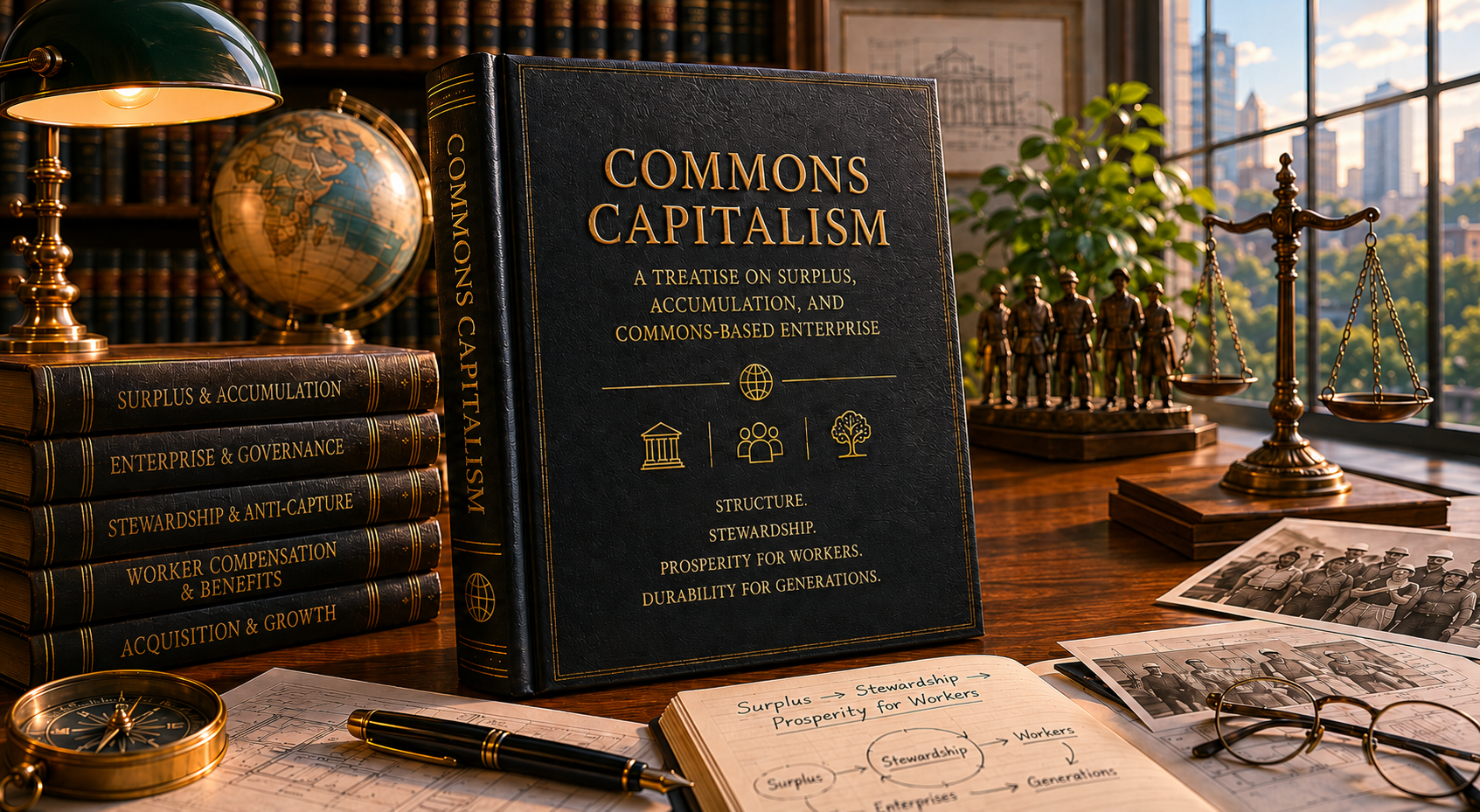
Commons Capitalism uses the Master’s tools to build a house that the Master can’t live in.
A Navigable Research Architecture for Commons Capitalism
This page assumes familiarity with the basic concepts of Commons Capitalism. New readers should begin with the Introduction to understand and appreciate the organizational structure described on this page.
The following CC Atlas reflects the current working architecture for Commons Capitalism — A Treatise on Surplus, Accumulation, and Commons-Based Enterprise. The Treatise is being developed as a comprehensive examination of surplus governance, accumulation, stewardship, enterprise structure, worker compensation systems, anti-capture governance, and the operation of competitive enterprises within a Commons Capitalism framework.
The Treatise did not emerge from abstract ideology or a single conceptual insight. The work developed gradually through continuing examination of worker compensation, enterprise surplus, institutional continuity, governance constraints, legal feasibility, and long-term accumulation. As the inquiry expanded, additional chapters and subject areas became necessary to address issues that conventional economic, legal, and organizational analysis often treats separately.
Accordingly, the Atlas is intentionally extensive. The organization reflects an effort to examine Commons Capitalism not as an isolated proposal, but as an integrated institutional system involving economics, law, governance, accumulation, market competition, organizational continuity, stewardship, and enterprise growth.
The Atlas also serves a developmental function. Commons Capitalism is being developed through a layered process that permits ideas, research, commentary, legal analysis, and drafting to be captured and organized before final chapter text is completed. The objective is to preserve emerging ideas, identify proper placement within the Treatise, and allow individual Parts and Chapters to develop independently while remaining connected to the larger architecture of the system.
At present, the development process operates through several levels. The Master Table of Contents functions as a topic-capture structure and placement map. The CC Atlas provides reader-oriented descriptions of the Treatise architecture. Chapter-development materials provide progressively greater detail through chapter, section, and subsection descriptions. Drafting files then convert those materials into chapter text, which ultimately becomes part of the published Treatise.
The Treatise remains under continuing development. Chapter titles, sequencing, subdivisions, and subject placement may evolve as additional research, drafting, commentary, and analysis are completed.
Readers are invited to explore the Atlas and identify areas of particular interest, disagreement, concern, or importance. Because Commons Capitalism intersects multiple disciplines simultaneously, readers often approach the project through different entry points, including economics, business governance, institutional design, nonprofit law, labor systems, accumulation theory, acquisition strategy, or enterprise operations.
The material below therefore serves not merely as a table of contents, but as a navigable intellectual architecture for the continuing development and examination of Commons Capitalism.
Reader Contributions and Published Responses
Commons Capitalism is intended to be examined, tested, criticized, and challenged. Readers are encouraged to submit observations, objections, critiques, alternative analyses, research references, contrary viewpoints, drafting suggestions, and overlooked issues for consideration.
Because Commons Capitalism intersects economics, law, governance, enterprise organization, worker compensation, accumulation theory, institutional design, and business operations, readers from different fields may identify concerns or opportunities that warrant further treatment within the Treatise.
Readers may participate through the Forum, by direct correspondence, or through any feedback forms provided on this website. Where appropriate, selected submissions may be discussed, analyzed, summarized, or responded to through updates to the CC Atlas, Commentary articles, Treatise materials, Forms, research priorities, or other portions of this website.
Readers should not assume that publication or response indicates agreement. Some submissions may be highlighted precisely because they identify important weaknesses, unresolved questions, implementation difficulties, legal concerns, governance risks, economic objections, or competing interpretations.
Constructive criticism is welcomed as an important part of the continuing development, stress testing, refinement, and improvement of Commons Capitalism.
Artificial intelligence tools were used for literature identification, organizational assistance, drafting support, and editorial revision. All substantive arguments, institutional designs, legal analysis, and conclusions are the work of the author.
Using the Atlas
The CC Atlas serves as a navigational architecture for Commons Capitalism and the Treatise. Its purpose is to help readers locate concepts, identify relationships among chapters and Parts, understand how individual subjects fit within the larger system, and follow the continuing development of the project.
Unlike the Treatise, the Atlas is not intended to be read sequentially from beginning to end. Readers may enter the Atlas through any Part, Chapter, issue, concept, or topic of interest. Economists, lawyers, business owners, governance scholars, workers, and general readers often approach Commons Capitalism through different entry points. The Atlas is designed to accommodate those different approaches.
The Atlas also performs a developmental function. Commons Capitalism is being developed through a continuing process of research, analysis, commentary, drafting, and revision. The Atlas helps preserve emerging ideas, identify proper placement within the Treatise, and maintain coherence among the many subjects that together comprise Commons Capitalism.
Readers seeking a guided introduction to Commons Capitalism should consult the Reader’s Roadmap contained in the Treatise. The Roadmap explains the recommended sequence for approaching the material and identifies suggested reading paths for different categories of readers.
Readers are encouraged to explore the Atlas, follow areas of particular interest, compare related topics across Parts, and identify questions, concerns, criticisms, or opportunities for further examination. Because Commons Capitalism intersects multiple disciplines simultaneously, readers frequently discover connections that are not immediately apparent when individual subjects are examined in isolation.
The Atlas is therefore intended not merely as a table of contents, but as a working map of the intellectual architecture of Commons Capitalism.
Front-End Architecture and Preface Chronology as Entry Ramp
Front-End Architecture
This opening section explains how the CC Atlas functions as a working map for Treatise development, publication, citation control, and website navigation. It gives readers enough context to understand that the Atlas is both a public guide and a private drafting framework.
A. Working Function of This Master TOC
This section organizes the main issues involved in A. Working Function of This Master TOC. It gives readers a map of Master TOC as hanging structure for future ideas, Master TOC as placement map for free-thinking notes, Master TOC as drafting control document, Master TOC as research assignment list, and Master TOC as cross-reference index and shows how those topics fit into the larger development of the Treatise.
A.1. Master TOC as hanging structure for future ideas
A.2. Master TOC as placement map for free-thinking notes
A.3. Master TOC as drafting control document
A.4. Master TOC as research assignment list
A.5. Master TOC as cross-reference index
A.6. Master TOC as website navigation blueprint
A.7. Master TOC as later published reader TOC source
B. Publication Forms
This section organizes the main issues involved in B. Publication Forms. It gives readers a map of Word master draft, PDF book download, Webpage version using Word-derived footnotes, Chapter webpages, and Part webpages and shows how those topics fit into the larger development of the Treatise.
B.1. Word master draft
B.2. PDF book download
B.3. Webpage version using Word-derived footnotes
B.4. Chapter webpages
B.5. Part webpages
B.6. Downloadable Part PDFs
B.7. Relationship between Treatise, Commentary, Forms, Origin, and Apologia pages
C. Footnote Reservation System
This section organizes the main issues involved in C. Footnote Reservation System. It gives readers a map of Part I reserved footnotes 1001-1999, Part II reserved footnotes 2001-2999, Part III reserved footnotes 3001-3999, Part IV reserved footnotes 4001-4999, and Part V reserved footnotes 5001-5999 and shows how those topics fit into the larger development of the Treatise.
C.1. Part I reserved footnotes 1001-1999
C.2. Part II reserved footnotes 2001-2999
C.3. Part III reserved footnotes 3001-3999
C.4. Part IV reserved footnotes 4001-4999
C.5. Part V reserved footnotes 5001-5999
C.6. Part VI reserved footnotes 6001-6999
C.7. Part VII reserved footnotes 7001-7999
C.8. Part VIII reserved footnotes 8001-8999
C.9. Part IX reserved footnotes 9001-9999
C.10. Part X reserved footnotes 10001-10999
C.11. Appendix footnote treatment
C.12. Citation control sheet by Part
Preface Chronology as Entry Ramp
This section preserves the developmental chronology that leads into the Treatise: the initial practical concern for workers, the rejection of inadequate funding paths, and the discovery of enterprise surplus as the decisive resource. It shows why the Treatise begins with surplus, accumulation, stewardship, and legal architecture rather than with abstract ideology.
0.1. Practical Starting Point
This section organizes the main issues involved in 0.1. Practical Starting Point. It gives readers a map of Worker wages as the initial practical problem, Stronger worker benefits as companion problem, Real businesses and real clients as background, Existing legal tools as raw material, and Rejection of abstract theory as origin story and shows how those topics fit into the larger development of the Treatise.
0.1.1. Worker wages as the initial practical problem
0.1.2. Stronger worker benefits as companion problem
0.1.3. Real businesses and real clients as background
0.1.4. Existing legal tools as raw material
0.1.5. Rejection of abstract theory as origin story
0.2. Excluded Funding Paths
This section organizes the main issues involved in 0.2. Excluded Funding Paths. It gives readers a map of Forced redistribution of private capital excluded, Government subsidy excluded as structural foundation, Government intervention into ordinary market activity excluded, Charitable funding excluded as system base, and Investor financing excluded as incompatible with surplus destination and shows how those topics fit into the larger development of the Treatise.
0.2.1. Forced redistribution of private capital excluded
0.2.2. Government subsidy excluded as structural foundation
0.2.3. Government intervention into ordinary market activity excluded
0.2.4. Charitable funding excluded as system base
0.2.5. Investor financing excluded as incompatible with surplus destination
0.3. Discovery of Enterprise Surplus as Funding Source
This section organizes the main issues involved in 0.3. Discovery of Enterprise Surplus as Funding Source. It gives readers a map of Net income as recurring internal source, Corporate surplus as potential wage and benefit funding source, Aggregate corporate surplus review, Top 1000 corporate net income data point, and Surprise of the surplus vista and shows how those topics fit into the larger development of the Treatise.
0.3.1. Net income as recurring internal source
0.3.2. Corporate surplus as potential wage and benefit funding source
0.3.3. Aggregate corporate surplus review
0.3.4. Top 1000 corporate net income data point
0.3.5. Surprise of the surplus vista
0.3.6. Shift from labor-help problem to enterprise-surplus problem
0.4. Acquisition Regimen Emerges
This section organizes the main issues involved in 0.4. Acquisition Regimen Emerges. It gives readers a map of Surplus potentially sufficient for wages and benefits, Surplus potentially sufficient for acquisition, Existing companies as acquisition targets, Future workers as beneficiaries through expansion, and Labor Capitalism naming possibility and shows how those topics fit into the larger development of the Treatise.
0.4.1. Surplus potentially sufficient for wages and benefits
0.4.2. Surplus potentially sufficient for acquisition
0.4.3. Existing companies as acquisition targets
0.4.4. Future workers as beneficiaries through expansion
0.4.5. Labor Capitalism naming possibility
0.4.6. Commons Capitalism naming decision
0.5. Commons Corporation as Necessary Institution
This section organizes the main issues involved in 0.5. Commons Corporation as Necessary Institution. It gives readers a map of Need for entity to receive surplus, Need for entity without private owners, Need for entity separate from market-facing operations, Need for entity capable of acquiring subsidiaries, and Need for entity capable of long-term stewardship and shows how those topics fit into the larger development of the Treatise.
0.5.1. Need for entity to receive surplus
0.5.2. Need for entity without private owners
0.5.3. Need for entity separate from market-facing operations
0.5.4. Need for entity capable of acquiring subsidiaries
0.5.5. Need for entity capable of long-term stewardship
0.6. Surplus as Commons
This section organizes the main issues involved in 0.6. Surplus as Commons. It gives readers a map of Disparate beneficiaries and institutional interests, Commons corporation interest, Existing Subsidiary interests, Later-acquired Subsidiary interests, and Present worker interests and shows how those topics fit into the larger development of the Treatise.
0.6.1. Disparate beneficiaries and institutional interests
0.6.2. Commons corporation interest
0.6.3. Existing Subsidiary interests
0.6.4. Later-acquired Subsidiary interests
0.6.5. Present worker interests
0.6.6. Future worker interests
0.6.7. Downturn flexibility through commons-based allocation
0.7. Intergenerational Continuity Emerges
This section organizes the main issues involved in 0.7. Intergenerational Continuity Emerges. It gives readers a map of Future workers as independent beneficiaries, Stewardship beyond present participants, Acquisition as intergenerational expansion mechanism, Institutional continuity as practical necessity, and Long-term accumulation as future-worker protection and shows how those topics fit into the larger development of the Treatise.
0.7.1. Future workers as independent beneficiaries
0.7.2. Stewardship beyond present participants
0.7.3. Acquisition as intergenerational expansion mechanism
0.7.4. Institutional continuity as practical necessity
0.7.5. Long-term accumulation as future-worker protection
0.7.6. Present-worker interests versus future-worker interests
0.7.7. Intergenerational obligations without ownership rights
0.7.8. Why future workers alter surplus-allocation decisions
0.7.9. Growth as worker inclusion rather than capital expansion
0.7.10. Intergenerational continuity as design constraint
0.8. Stewardship Emerges as Structural Necessity
This section organizes the main issues involved in 0.8. Stewardship Emerges as Structural Necessity. It gives readers a map of Stewardship not as slogan, Stewardship as allocation discipline, Stewardship as anti-capture constraint, Stewardship as governance function, and Stewardship not executive management and shows how those topics fit into the larger development of the Treatise.
0.8.1. Stewardship not as slogan
0.8.2. Stewardship as allocation discipline
0.8.3. Stewardship as anti-capture constraint
0.8.4. Stewardship as governance function
0.8.5. Stewardship not executive management
0.8.6. Board-governed surplus allocation
0.9. Transition from Chronology to Treatise
This section organizes the main issues involved in 0.9. Transition from Chronology to Treatise. It gives readers a map of Chronology explains why the Treatise begins with surplus, Chronology explains why markets are not the first issue, Chronology explains why acquisition becomes core purpose, Chronology explains why legal architecture matters, and Chronology explains why technical Parts follow and shows how those topics fit into the larger development of the Treatise.
0.9.1. Chronology explains why the Treatise begins with surplus
0.9.2. Chronology explains why markets are not the first issue
0.9.3. Chronology explains why acquisition becomes core purpose
0.9.4. Chronology explains why legal architecture matters
0.9.5. Chronology explains why technical Parts follow
Part I. The Fault Line
Part I identifies the central analytical fault line of Commons Capitalism: who controls and accumulates enterprise surplus over time. It explains why the Treatise begins with purposes, surplus, and accumulation before turning to capitalism, socialism, markets, and institutional design.
Chapter 1. Purposes Before System Labels
This chapter begins with the practical purposes that first drove the inquiry: premium wages, stronger social benefits, and later the acquisition of existing businesses for future workers. It prevents readers from forcing Commons Capitalism into preexisting labels before understanding what the system is trying to accomplish.
I.1.1. Initial question of helping workers
I.1.2. Premium wages as primary purpose
I.1.3. Stronger social benefits as primary purpose
I.1.4. Acquisition of existing businesses as later-recognized purpose
I.1.5. Future workers as expansion beneficiaries
I.1.6. Enterprise continuity as instrumental necessity
I.1.7. Worker benefit without worker ownership
I.1.8. Distinguishing purpose from mechanism
I.1.9. Distinguishing humane result from charity
I.1.10. Treatise scope limited to enterprise surplus governance
I.1.11. Threshold Questions and Preliminary Answers
Chapter 2. Surplus, Not Markets
This chapter separates market exchange from surplus control. It explains why preserving markets does not preserve capitalism if private surplus accumulation is removed, and why abolishing markets would miss the specific problem Commons Capitalism addresses.
I.2.1. Markets as exchange mechanisms
I.2.2. Prices as market signals
I.2.3. Competition as market discipline
I.2.4. Surplus as post-exchange enterprise result
I.2.5. Surplus control as separate from market pricing
I.2.6. Surplus ownership as separate from consumer choice
I.2.7. Surplus allocation as separate from production decisions
I.2.8. Why market abolition misses the problem
I.2.9. Why market preservation does not preserve capitalism by itself
I.2.10. Why accumulation, not exchange, is the central problem
Chapter 3. The Fault Line Concept
This chapter defines the Fault Line as the point at which an economic system decides who controls surplus, enterprise income, productive assets, or accumulation power. It then applies that concept to capitalism, socialism, and Commons Capitalism to show why each system locates the decisive intervention differently.
I.3.1. Definition of the Fault Line
I.3.2. Point where surplus becomes accumulation
I.3.3. Point where enterprise income becomes institutional power
I.3.4. Ownership of productive assets as one possible fault-line placement
I.3.5. Control of enterprise income as one possible fault-line placement
I.3.6. Allocation of surplus as one possible fault-line placement
I.3.7. Planning authority as one possible fault-line placement
I.3.8. Market exchange as mistaken fault-line placement for Commons Capitalism
I.3.9. Long-term accumulation as decisive fault-line placement
I.3.10. Fault Line applied to capitalism
I.3.11. Fault Line applied to socialism
I.3.12. Fault Line applied to Commons Capitalism
Chapter 4. Capitalism as Private Surplus Capture
This chapter examines capitalism as a system in which private residual claimants control net profits and accumulate surplus over time. It shows how retained earnings, reinvestment, acquisitions, liquidity, and distributions reproduce capitalist power through private surplus capture.
I.4.1. Private residual claimant
I.4.2. Private claim to net profits
I.4.3. Profit as return to capital owners
I.4.4. Shareholder primacy and residual claims
I.4.5. Investor exit and liquidity
I.4.6. Compounding through retained earnings
I.4.7. Capital accumulation through reinvestment
I.4.8. Accumulation through acquisition
I.4.9. Concentration of wealth through surplus capture
I.4.10. Systemic reproduction of capitalism through surplus control
Chapter 5. Socialism as Response to Private Capture
This chapter treats socialism as a family of responses to private surplus capture rather than as one uniform model. It explains why Commons Capitalism cannot place the Fault Line where socialism usually places it, because Commons Capitalism preserves competitive enterprise while changing surplus destination.
I.5.1. Socialism as family of responses
I.5.2. Public ownership response
I.5.3. Collective ownership response
I.5.4. Worker ownership response
I.5.5. Planning response
I.5.6. Redistribution response
I.5.7. Market subordination response
I.5.8. Why socialism places the fault line differently
I.5.9. Why Commons Capitalism cannot place the fault line where socialism places it
I.5.10. Why Commons Capitalism is not socialism
Chapter 6. The Design Constraint
This chapter states the central design constraint: change surplus governance and accumulation without abolishing markets, competition, private property generally, or ordinary enterprise discipline. It defines the narrow but demanding path Commons Capitalism must follow if it is to remain neither capitalist nor socialist.
I.6.1. Changing accumulation without abolishing markets
I.6.2. Changing surplus governance without public ownership
I.6.3. Changing surplus governance without collective ownership
I.6.4. Changing surplus governance without worker ownership
I.6.5. Changing surplus governance without charitable purpose
I.6.6. Changing surplus governance without government subsidy
I.6.7. Changing surplus governance without tax-and-transfer dependency
I.6.8. Preserving enterprise competition
I.6.9. Preserving ordinary market activity
I.6.10. Preserving operational business discipline
Chapter 7. The Scope Boundary
This chapter clarifies what Commons Capitalism does and does not attempt to do. It limits the system to enterprise surplus governance while leaving taxation, redistribution, labor law, antitrust, charity, humanitarian work, and cultural functions to their proper external domains.
I.7.1. Enterprise surplus governance as scope
I.7.2. Taxation left to government
I.7.3. Redistribution left to government
I.7.4. Charity left to civil society
I.7.5. Cultural work left to civil society
I.7.6. Humanitarian functions left to civil society
I.7.7. Labor law as external legal environment
I.7.8. Antitrust as external legal environment
I.7.9. No claim to solve every social problem
I.7.10. Structural modesty with systemic ambition
Chapter 8. The Reader’s First Misreadings
This chapter anticipates the first mistakes many readers are likely to make. It distinguishes Commons Capitalism from cooperatives, socialism, charity, ESG, stakeholder capitalism, public ownership, public-benefit capitalism, labor-owned capital, capital-as-commons theories, and policy programs.
I.8.1. Misreading Commons Capitalism as cooperatives
I.8.2. Misreading Commons Capitalism as socialism
I.8.3. Misreading Commons Capitalism as charity
I.8.4. Misreading Commons Capitalism as ESG
I.8.5. Misreading Commons Capitalism as stakeholder capitalism
I.8.6. Misreading Commons Capitalism as public-benefit capitalism
I.8.7. Misreading Commons Capitalism as public ownership
I.8.8. Misreading Commons Capitalism as labor-owned capital
I.8.9. Misreading Commons Capitalism as capital as commons
I.8.10. Misreading Commons Capitalism as policy program
Part II. Capitalism, Socialism, and the Insufficiency of Partial Remedies
Part II compares Commons Capitalism with capitalism, socialism, social democracy, cooperatives, ESOPs, stakeholder models, and other partial remedies. Its purpose is to show why many familiar reforms ameliorate effects, redistribute outcomes, or change governance language without relocating long-term surplus control.
Chapter 1. Capitalism’s Accumulation Logic
This chapter examines Capitalism’s Accumulation Logic as a necessary component of the Commons Capitalism architecture. It focuses on Profit maximization norm, Private capital accumulation, Owner wealth compounding, Investor discipline, and Residual claimant discipline so readers can see how this subject supports the larger surplus-governance analysis.
II.1.1. Profit maximization norm
II.1.2. Private capital accumulation
II.1.3. Owner wealth compounding
II.1.4. Investor discipline
II.1.5. Residual claimant discipline
II.1.6. Managerial agency within owner-centered firm
II.1.7. Corporate retained earnings
II.1.8. Dividends and distributions
II.1.9. Share repurchases
II.1.10. Acquisition as capitalist consolidation
Chapter 2. Capitalism’s Worker Problem
This chapter examines Capitalism’s Worker Problem as a necessary component of the Commons Capitalism architecture. It focuses on Wages as cost, Benefits as cost, Labor bargaining limits, Productivity gains and distribution, and Precarity and dependence so readers can see how this subject supports the larger surplus-governance analysis.
II.2.1. Wages as cost
II.2.2. Benefits as cost
II.2.3. Labor bargaining limits
II.2.4. Productivity gains and distribution
II.2.5. Precarity and dependence
II.2.6. Employment at will
II.2.7. Benefit insecurity
II.2.8. Wage compression
II.2.9. Corporate surplus versus worker claims
II.2.10. Why wage regulation does not change surplus control
Chapter 3. Socialist Responses and Their Limits
This chapter examines Socialist Responses and Their Limits as a necessary component of the Commons Capitalism architecture. It focuses on State ownership, Public planning, Collective ownership, Worker control, and Market socialism so readers can see how this subject supports the larger surplus-governance analysis.
II.3.1. State ownership
II.3.2. Public planning
II.3.3. Collective ownership
II.3.4. Worker control
II.3.5. Market socialism
II.3.6. Democratic socialism
II.3.7. Social ownership of capital
II.3.8. Political dependency of socialist transition
II.3.9. Enterprise competition under socialism
II.3.10. Why Commons Capitalism rejects socialist placement of the fault line
Chapter 4. Social Democracy and Welfare-State Capitalism
This chapter examines Social Democracy and Welfare-State Capitalism as a necessary component of the Commons Capitalism architecture. It focuses on Tax-and-transfer systems, Universal benefits, Wage supports, Public healthcare, and Public education support so readers can see how this subject supports the larger surplus-governance analysis.
II.4.1. Tax-and-transfer systems
II.4.2. Universal benefits
II.4.3. Wage supports
II.4.4. Public healthcare
II.4.5. Public education support
II.4.6. Labor protections
II.4.7. Redistribution after private accumulation
II.4.8. Persistence of private residual claims
II.4.9. Political fragility
II.4.10. Why social democracy ameliorates without replacing capitalist accumulation
Chapter 5. Worker Cooperatives and Cooperative Literature
This chapter examines Worker Cooperatives and Cooperative Literature as a necessary component of the Commons Capitalism architecture. It focuses on Cooperative ownership, Worker-member control, Patronage and surplus distribution, Democratic governance, and Capital constraints so readers can see how this subject supports the larger surplus-governance analysis.
II.5.1. Cooperative ownership
II.5.2. Worker-member control
II.5.3. Patronage and surplus distribution
II.5.4. Democratic governance
II.5.5. Capital constraints
II.5.6. Horizon problems
II.5.7. Membership boundaries
II.5.8. Worker-owner capture risk
II.5.9. Difference between worker voice and worker ownership
II.5.10. Why CCEs are not cooperatives in any way
Chapter 6. ESOPs and Employee Ownership
This chapter examines ESOPs and Employee Ownership as a necessary component of the Commons Capitalism architecture. It focuses on ESOP trust structure, Employee beneficial interests, Share ownership through plan, Retirement wealth orientation, and Repurchase obligations so readers can see how this subject supports the larger surplus-governance analysis.
II.6.1. ESOP trust structure
II.6.2. Employee beneficial interests
II.6.3. Share ownership through plan
II.6.4. Retirement wealth orientation
II.6.5. Repurchase obligations
II.6.6. Capital markets and exit value
II.6.7. Ownership-based worker benefit
II.6.8. Persistence of equity logic
II.6.9. Distinguishing premium wages from capital wealth accumulation
II.6.10. Why ESOPs do not solve the surplus-governance problem
Chapter 7. Stakeholder Capitalism, ESG, and Benefit Corporations
This chapter examines Stakeholder Capitalism, ESG, and Benefit Corporations as a necessary component of the Commons Capitalism architecture. It focuses on Stakeholder rhetoric, Board discretion toward stakeholders, Benefit corporation purpose statements, ESG metrics, and Sustainability reporting so readers can see how this subject supports the larger surplus-governance analysis.
II.7.1. Stakeholder rhetoric
II.7.2. Board discretion toward stakeholders
II.7.3. Benefit corporation purpose statements
II.7.4. ESG metrics
II.7.5. Sustainability reporting
II.7.6. Managerial discretion problem
II.7.7. Investor compatibility problem
II.7.8. Residual claimant persistence
II.7.9. Mission versus accumulation
II.7.10. Why stakeholder models do not abolish private surplus capture
Chapter 8. Mutualism, Distributism, Georgism, and Decentralist Proposals
This chapter examines Mutualism, Distributism, Georgism, and Decentralist Proposals as a necessary component of the Commons Capitalism architecture. It focuses on Mutualist exchange, Distributist widespread ownership, Georgist land value taxation, Small proprietorship ideal, and Decentralized capital ownership so readers can see how this subject supports the larger surplus-governance analysis.
II.8.1. Mutualist exchange
II.8.2. Distributist widespread ownership
II.8.3. Georgist land value taxation
II.8.4. Small proprietorship ideal
II.8.5. Decentralized capital ownership
II.8.6. Anti-monopoly orientation
II.8.7. Private ownership persistence
II.8.8. State tax dependency
II.8.9. Scale limitation
II.8.10. Failure to create ownerless surplus-governance enterprise form
Chapter 9. Social Wealth Funds, Sovereign Funds, and UBI
This chapter examines Social Wealth Funds, Sovereign Funds, and UBI as a necessary component of the Commons Capitalism architecture. It focuses on Social wealth fund design, Public investment funds, Universal basic income, Citizen dividends, and Broad public beneficiary class so readers can see how this subject supports the larger surplus-governance analysis.
II.9.1. Social wealth fund design
II.9.2. Public investment funds
II.9.3. Universal basic income
II.9.4. Citizen dividends
II.9.5. Broad public beneficiary class
II.9.6. State ownership or state distribution
II.9.7. Separation from enterprise governance
II.9.8. Redistribution rather than internal surplus stewardship
II.9.9. Political administration problem
II.9.10. Why public funds do not create CCE architecture
Chapter 10. Community Wealth Building and Localist Reforms
This chapter examines Community Wealth Building and Localist Reforms as a necessary component of the Commons Capitalism architecture. It focuses on Anchor institutions, Local procurement, Community development corporations, Municipal enterprise, and Local ownership strategies so readers can see how this subject supports the larger surplus-governance analysis.
II.10.1. Anchor institutions
II.10.2. Local procurement
II.10.3. Community development corporations
II.10.4. Municipal enterprise
II.10.5. Local ownership strategies
II.10.6. Place-based capital retention
II.10.7. Scale limitations
II.10.8. Public and philanthropic dependency
II.10.9. Localism versus enterprise surplus governance
II.10.10. Why community wealth building is not Commons Capitalism
Chapter 11. Platform Cooperativism and Digital Commons Proposals
This chapter examines Platform Cooperativism and Digital Commons Proposals as a necessary component of the Commons Capitalism architecture. It focuses on Platform cooperative ownership, Data commons, Open-source governance, Digital labor platforms, and Network effects so readers can see how this subject supports the larger surplus-governance analysis.
II.11.1. Platform cooperative ownership
II.11.2. Data commons
II.11.3. Open-source governance
II.11.4. Digital labor platforms
II.11.5. Network effects
II.11.6. Venture-financed platform competition
II.11.7. Cooperative scaling limits
II.11.8. Commons rhetoric versus surplus architecture
II.11.9. Digital commons and enterprise surplus distinction
II.11.10. Why platform cooperativism does not generalize to CCEs
Chapter 12. Antitrust, Labor Law, and Regulatory Reform
This chapter examines Antitrust, Labor Law, and Regulatory Reform as a necessary component of the Commons Capitalism architecture. It focuses on Antitrust enforcement, Monopoly and concentration control, Labor standards, Minimum wage laws, and Collective bargaining law so readers can see how this subject supports the larger surplus-governance analysis.
II.12.1. Antitrust enforcement
II.12.2. Monopoly and concentration control
II.12.3. Labor standards
II.12.4. Minimum wage laws
II.12.5. Collective bargaining law
II.12.6. Employment protections
II.12.7. Regulation as external constraint
II.12.8. Private accumulation after compliance
II.12.9. Government enforcement dependency
II.12.10. Why regulation does not relocate surplus ownership
Chapter 13. Comparative Test for All Proposed Remedies
This chapter examines Comparative Test for All Proposed Remedies as a necessary component of the Commons Capitalism architecture. It focuses on Problem identified by proposal, Mechanism used by proposal, Ownership change test, Surplus-control change test, and Accumulation change test so readers can see how this subject supports the larger surplus-governance analysis.
II.13.1. Problem identified by proposal
II.13.2. Mechanism used by proposal
II.13.3. Ownership change test
II.13.4. Surplus-control change test
II.13.5. Accumulation change test
II.13.6. Market-preservation test
II.13.7. Enterprise-competition test
II.13.8. Government-dependency test
II.13.9. Residual-claim test
II.13.10. Scale-without-capture test
Part III. Genealogy, Legal Materials, and Conceptual Sources
Part III situates Commons Capitalism among the legal, institutional, and conceptual materials that make the system intelligible without treating those materials as direct sources of the design. It examines commons concepts, corporate law, nonprofit law, tax classification, and terminology discipline as tools recombined for a new surplus-governance purpose.
Chapter 1. Genealogy of Commons Capitalism
This chapter examines Genealogy of Commons Capitalism as a necessary component of the Commons Capitalism architecture. It focuses on Pre-capitalist commons background, Custom and shared resource governance, Enclosure as background contrast, Primitive accumulation as system comparison, and Corporate law as enabling technology so readers can see how this subject supports the larger surplus-governance analysis.
III.1.1. Pre-capitalist commons background
III.1.2. Custom and shared resource governance
III.1.3. Enclosure as background contrast
III.1.4. Primitive accumulation as system comparison
III.1.5. Corporate law as enabling technology
III.1.6. Nonprofit law as enabling technology
III.1.7. Trust and fiduciary ideas as adjacent concepts
III.1.8. Commons governance literature
III.1.9. Worker-benefit history
III.1.10. Recombination into CCE architecture
Chapter 2. Commons Concepts and Their Limits
This chapter examines Commons Concepts and Their Limits as a necessary component of the Commons Capitalism architecture. It focuses on Natural-resource commons, Knowledge commons, Digital commons, Institutional commons, and Common-pool resources so readers can see how this subject supports the larger surplus-governance analysis.
III.2.1. Natural-resource commons
III.2.2. Knowledge commons
III.2.3. Digital commons
III.2.4. Institutional commons
III.2.5. Common-pool resources
III.2.6. Rules against extraction
III.2.7. Governance among competing users
III.2.8. Why enterprise surplus is different
III.2.9. Why capital is not the commons
III.2.10. Why surplus is governed as a commons
Chapter 3. Corporate Law Building Blocks
This chapter examines Corporate Law Building Blocks as a necessary component of the Commons Capitalism architecture. It focuses on Legal personhood, Separate entity principle, Limited liability, Board governance, and Fiduciary duties so readers can see how this subject supports the larger surplus-governance analysis.
III.3.1. Legal personhood
III.3.2. Separate entity principle
III.3.3. Limited liability
III.3.4. Board governance
III.3.5. Fiduciary duties
III.3.6. Ownership of subsidiaries
III.3.7. Corporate groups
III.3.8. Parent-subsidiary relationship
III.3.9. Internal governance documents
III.3.10. Entity durability
Chapter 4. Nonprofit Corporation Building Blocks
This chapter examines Nonprofit Corporation Building Blocks as a necessary component of the Commons Capitalism architecture. It focuses on Nonmember nonprofit corporation, No shareholders, No members, No private residual claimants, and Noncharitable nonprofit possibilities so readers can see how this subject supports the larger surplus-governance analysis.
III.4.1. Nonmember nonprofit corporation
III.4.2. No shareholders
III.4.3. No members
III.4.4. No private residual claimants
III.4.5. Noncharitable nonprofit possibilities
III.4.6. Statutory flexibility
III.4.7. Articles of incorporation
III.4.8. Bylaws
III.4.9. Board-centered governance
III.4.10. Jurisdiction-neutral drafting
Chapter 5. Tax Law and Classification Background
This chapter examines Tax Law and Classification Background as a necessary component of the Commons Capitalism architecture. It focuses on Nonprofit status versus tax exemption, No 501(c)(3) qualification, No 501(c)(4) qualification, Federal income tax posture, and Unrelated business income issues so readers can see how this subject supports the larger surplus-governance analysis.
III.5.1. Nonprofit status versus tax exemption
III.5.2. No 501(c)(3) qualification
III.5.3. No 501(c)(4) qualification
III.5.4. Federal income tax posture
III.5.5. Unrelated business income issues
III.5.6. Consolidated group questions
III.5.7. Parent-subsidiary tax flows
III.5.8. Tax hostility to commons corporation
III.5.9. Tax compliance as design constraint
III.5.10. Need for specialist tax analysis
Chapter 6. Why Existing Legal Tools Are Enough to Begin
This chapter examines Why Existing Legal Tools Are Enough to Begin as a necessary component of the Commons Capitalism architecture. It focuses on New use of familiar tools, Not dependent on new federal statute, Not dependent on special tax subsidy, Not dependent on charitable status, and Not dependent on public ownership so readers can see how this subject supports the larger surplus-governance analysis.
III.6.1. New use of familiar tools
III.6.2. Not dependent on new federal statute
III.6.3. Not dependent on special tax subsidy
III.6.4. Not dependent on charitable status
III.6.5. Not dependent on public ownership
III.6.6. Importance of state nonprofit corporation law
III.6.7. Importance of subsidiary entity law
III.6.8. Importance of contract and employment law
III.6.9. Importance of governance drafting
III.6.10. Legal feasibility as architecture problem
Chapter 7. Terminology Discipline
This chapter examines Terminology Discipline as a necessary component of the Commons Capitalism architecture. It focuses on Commons Capitalism, Commons Capitalism Entity, Commons corporation, Subsidiary, and Worker so readers can see how this subject supports the larger surplus-governance analysis.
III.7.1. Commons Capitalism
III.7.2. Commons Capitalism Entity
III.7.3. Commons corporation
III.7.4. Subsidiary
III.7.5. Worker
III.7.6. Surplus
III.7.7. Net profits
III.7.8. Stewardship
III.7.9. No residual claims
III.7.10. No business conversion terminology
Part IV. The Commons Capitalism Entity Architecture
Part IV explains the CCE as an integrated legal and institutional architecture consisting of a nonmember nonprofit commons corporation and one or more wholly owned market-facing Subsidiaries. It shows why parent-subsidiary separation, formation documents, bylaws, and scaled versions are necessary to preserve commons stewardship without impairing ordinary business operations.
Chapter 1. Definition of the CCE
This chapter examines Definition of the CCE as a necessary component of the Commons Capitalism architecture. It focuses on CCE as integrated entity structure, Commons corporation plus Subsidiaries, Commons corporation alone is not the entire CCE, Nonmember nonprofit parent, and Wholly owned market-facing Subsidiaries so readers can see how this subject supports the larger surplus-governance analysis.
IV.1.1. CCE as integrated entity structure
IV.1.2. Commons corporation plus Subsidiaries
IV.1.3. Commons corporation alone is not the entire CCE
IV.1.4. Nonmember nonprofit parent
IV.1.5. Wholly owned market-facing Subsidiaries
IV.1.6. No shareholders in commons corporation
IV.1.7. No members in commons corporation
IV.1.8. No investors of any kind
IV.1.9. No private residual claimants
IV.1.10. Surplus retained for commons purposes
Chapter 2. The Commons Corporation
This chapter examines The Commons Corporation as a necessary component of the Commons Capitalism architecture. It focuses on Legal status, Nonmember structure, No public purpose, No charitable purpose, and No market-facing operational role so readers can see how this subject supports the larger surplus-governance analysis.
IV.2.1. Legal status
IV.2.2. Nonmember structure
IV.2.3. No public purpose
IV.2.4. No charitable purpose
IV.2.5. No market-facing operational role
IV.2.6. Surplus governance role
IV.2.7. Subsidiary ownership role
IV.2.8. Acquisition role
IV.2.9. Fund administration role
IV.2.10. Stewardship role
Chapter 3. Subsidiaries
This chapter examines Subsidiaries as a necessary component of the Commons Capitalism architecture. It focuses on Wholly owned by commons corporation, Market-facing operations, Board designation requirement, Profit-seeking operations, and Ordinary competition so readers can see how this subject supports the larger surplus-governance analysis.
IV.3.1. Wholly owned by commons corporation
IV.3.2. Market-facing operations
IV.3.3. Board designation requirement
IV.3.4. Profit-seeking operations
IV.3.5. Ordinary competition
IV.3.6. Separate subsidiary boards
IV.3.7. Subsidiary management authority
IV.3.8. Operational efficiency
IV.3.9. Profit remittance
IV.3.10. No non-wholly-owned controlled entities as Subsidiaries
Chapter 4. Parent-Subsidiary Separation
This chapter examines Parent-Subsidiary Separation as a necessary component of the Commons Capitalism architecture. It focuses on Commons corporation separated from market-facing duties, Subsidiaries conduct business operations, Avoiding conflicting missions, Avoiding parent operational incompetence, and Avoiding centralized business micromanagement so readers can see how this subject supports the larger surplus-governance analysis.
IV.4.1. Commons corporation separated from market-facing duties
IV.4.2. Subsidiaries conduct business operations
IV.4.3. Avoiding conflicting missions
IV.4.4. Avoiding parent operational incompetence
IV.4.5. Avoiding centralized business micromanagement
IV.4.6. Owner oversight without operational takeover
IV.4.7. Board directives to subsidiary boards
IV.4.8. Subsidiary autonomy within CCE structure
IV.4.9. Accountability for performance
IV.4.10. Group coherence without single operating company model
Chapter 5. Articles of Incorporation Architecture
This chapter examines Articles of Incorporation Architecture as a necessary component of the Commons Capitalism architecture. It focuses on Name and commons identity, Principal office and registered office, Duration, Powers, and Commons purposes so readers can see how this subject supports the larger surplus-governance analysis.
IV.5.1. Name and commons identity
IV.5.2. Principal office and registered office
IV.5.3. Duration
IV.5.4. Powers
IV.5.5. Commons purposes
IV.5.6. No members or shareholders
IV.5.7. Establishment of Funds
IV.5.8. Appointment and election of directors
IV.5.9. Amendments and bylaws
IV.5.10. Dissolution
Chapter 6. Bylaw Architecture
This chapter examines Bylaw Architecture as a necessary component of the Commons Capitalism architecture. It focuses on Board procedures, Officer roles, Committees, Worker committees, and Subsidiary reporting so readers can see how this subject supports the larger surplus-governance analysis.
IV.6.1. Board procedures
IV.6.2. Officer roles
IV.6.3. Committees
IV.6.4. Worker committees
IV.6.5. Subsidiary reporting
IV.6.6. Budget procedures
IV.6.7. Fund procedures
IV.6.8. Conflict procedures
IV.6.9. Records and transparency
IV.6.10. Enforcement mechanisms
Chapter 7. MCCE and FCCE Versions
This chapter examines MCCE and FCCE Versions as a necessary component of the Commons Capitalism architecture. It focuses on Mature CCE naming issue, MCCE as full structured form, FCCE as foundational form, Simplified governance in FCCE, and Simplified fund rules in FCCE so readers can see how this subject supports the larger surplus-governance analysis.
IV.7.1. Mature CCE naming issue
IV.7.2. MCCE as full structured form
IV.7.3. FCCE as foundational form
IV.7.4. Simplified governance in FCCE
IV.7.5. Simplified fund rules in FCCE
IV.7.6. Growth path from FCCE to MCCE
IV.7.7. Minimum CCE requirements
IV.7.8. Scaling thresholds
IV.7.9. When advanced controls become necessary
IV.7.10. Model Forms relationship
Part V. Surplus as a Commons and the Four funds
Part V develops the internal surplus-governance system of Commons Capitalism. It explains why surplus is governed as a commons and how the Reinvestment Fund, Social Benefits Fund, Education Fund, and Reserve Fund operate as the only authorized channels for surplus allocation.
Chapter 1. Surplus and Net Profits
This chapter examines Surplus and Net Profits as a necessary component of the Commons Capitalism architecture. It focuses on Gross revenue, Operating expenses, Subsidiary net profits, Operating reserves, and Net profits after operating reserves so readers can see how this subject supports the larger surplus-governance analysis.
V.1.1. Gross revenue
V.1.2. Operating expenses
V.1.3. Subsidiary net profits
V.1.4. Operating reserves
V.1.5. Net profits after operating reserves
V.1.6. Consolidated returns
V.1.7. Reasonable net returns
V.1.8. Surplus available for allocation
V.1.9. Cash versus accounting income
V.1.10. Timing of allocations
Chapter 2. Why Surplus Is Governed as a Commons
This chapter examines Why Surplus Is Governed as a Commons as a necessary component of the Commons Capitalism architecture. It focuses on No private ownership of surplus, No worker ownership of surplus, No managerial ownership of surplus, No public ownership of surplus, and Competing internal claims so readers can see how this subject supports the larger surplus-governance analysis.
V.2.1. No private ownership of surplus
V.2.2. No worker ownership of surplus
V.2.3. No managerial ownership of surplus
V.2.4. No public ownership of surplus
V.2.5. Competing internal claims
V.2.6. Present worker claims
V.2.7. Future worker claims
V.2.8. Subsidiary stability claims
V.2.9. Acquisition claims
V.2.10. Reserve claims
Chapter 3. Stewardship Discipline
This chapter examines Stewardship Discipline as a necessary component of the Commons Capitalism architecture. It focuses on Stewardship as governance function, Stewardship as allocation discipline, Stewardship as anti-enclosure constraint, Stewardship as anti-mismanagement constraint, and Stewardship as anti-presentist constraint so readers can see how this subject supports the larger surplus-governance analysis.
V.3.1. Stewardship as governance function
V.3.2. Stewardship as allocation discipline
V.3.3. Stewardship as anti-enclosure constraint
V.3.4. Stewardship as anti-mismanagement constraint
V.3.5. Stewardship as anti-presentist constraint
V.3.6. Stewardship as anti-bureaucratic constraint
V.3.7. Stewardship as anti-managerial-capture constraint
V.3.8. Stewardship as multi-generational obligation
V.3.9. Stewardship and board judgment
V.3.10. Stewardship and written findings
Chapter 4. The Four Funds
This chapter examines The Four Funds as a necessary component of the Commons Capitalism architecture. It focuses on Reinvestment Fund, Social Benefits Fund, Education Fund, Reserve Fund, and No other fund names so readers can see how this subject supports the larger surplus-governance analysis.
V.4.1. Reinvestment Fund
V.4.2. Social Benefits Fund
V.4.3. Education Fund
V.4.4. Reserve Fund
V.4.5. No other fund names
V.4.6. Baseline allocation percentages
V.4.7. Fixed percentages versus board variance
V.4.8. Extraordinary variance standards
V.4.9. Written findings for variance
V.4.10. Fund integrity
Chapter 5. Reinvestment Fund
This chapter examines Reinvestment Fund as a necessary component of the Commons Capitalism architecture. It focuses on Acquisition financing, Expansion of existing Subsidiaries, Capital improvements, Debt reduction, and Internal capitalization so readers can see how this subject supports the larger surplus-governance analysis.
V.5.1. Acquisition financing
V.5.2. Expansion of existing Subsidiaries
V.5.3. Capital improvements
V.5.4. Debt reduction
V.5.5. Internal capitalization
V.5.6. Long-term scaling
V.5.7. Subsidiary support
V.5.8. Acquisition pipeline
V.5.9. Due diligence costs
V.5.10. Patient accumulation
Chapter 6. Social Benefits Fund
This chapter examines Social Benefits Fund as a necessary component of the Commons Capitalism architecture. It focuses on Premium wages relationship, Healthcare support, Retirement support, Paid leave support, and Childcare support so readers can see how this subject supports the larger surplus-governance analysis.
V.6.1. Premium wages relationship
V.6.2. Healthcare support
V.6.3. Retirement support
V.6.4. Paid leave support
V.6.5. Childcare support
V.6.6. Disability support
V.6.7. Family support
V.6.8. Benefit equalization among Subsidiaries
V.6.9. Nordic-like benefit concept
V.6.10. Limits on benefit expectations
Chapter 7. Education Fund
This chapter examines Education Fund as a necessary component of the Commons Capitalism architecture. It focuses on Workforce development, Continuing education, Trade and technical training, Professional credentials, and Management development so readers can see how this subject supports the larger surplus-governance analysis.
V.7.1. Workforce development
V.7.2. Continuing education
V.7.3. Trade and technical training
V.7.4. Professional credentials
V.7.5. Management development
V.7.6. Commons Capitalism education
V.7.7. Worker advancement
V.7.8. Subsidiary skill needs
V.7.9. Future worker preparation
V.7.10. Education Fund controls
Chapter 8. Reserve Fund
This chapter examines Reserve Fund as a necessary component of the Commons Capitalism architecture. It focuses on Stabilization reserve, Downturn flexibility, Emergency liquidity, Benefit preservation, and Subsidiary shock absorption so readers can see how this subject supports the larger surplus-governance analysis.
V.8.1. Stabilization reserve
V.8.2. Downturn flexibility
V.8.3. Emergency liquidity
V.8.4. Benefit preservation
V.8.5. Subsidiary shock absorption
V.8.6. Acquisition timing reserve
V.8.7. Covenant compliance support
V.8.8. Catastrophic event planning
V.8.9. Minimum reserve thresholds
V.8.10. Reserve release standards
Chapter 9. Notional Subaccounts and Equalization
This chapter examines Notional Subaccounts and Equalization as a necessary component of the Commons Capitalism architecture. It focuses on Subsidiary contribution tracking, Notional accounts, Avoiding ownership implications, Cross-subsidy authority, and Equalization among Subsidiaries so readers can see how this subject supports the larger surplus-governance analysis.
V.9.1. Subsidiary contribution tracking
V.9.2. Notional accounts
V.9.3. Avoiding ownership implications
V.9.4. Cross-subsidy authority
V.9.5. Equalization among Subsidiaries
V.9.6. Weaker Subsidiary support
V.9.7. Stronger Subsidiary expectations
V.9.8. Internal fairness concerns
V.9.9. Transparency of allocations
V.9.10. Anti-entitlement drafting
Chapter 10. Parent-Funded Programs
This chapter examines Parent-Funded Programs as a necessary component of the Commons Capitalism architecture. It focuses on Promotional programs, Pricing support, Rebates, Trial-support programs, and Wage-support programs so readers can see how this subject supports the larger surplus-governance analysis.
V.10.1. Promotional programs
V.10.2. Pricing support
V.10.3. Rebates
V.10.4. Trial-support programs
V.10.5. Wage-support programs
V.10.6. Measurement policies
V.10.7. Sunset policies
V.10.8. Avoiding hidden subsidies
V.10.9. Avoiding operational micromanagement
V.10.10. Board authorization standards
Part VI. Governance, Anti-Capture, and Institutional Discipline
Part VI examines the governance machinery needed to prevent Commons Capitalism from being captured by managers, directors, workers, subsidiaries, present beneficiaries, or bureaucracy. It focuses on board-centered stewardship, officer limits, ombudsman functions, SPOL oversight, committees, conflicts, dispute resolution, no-residual-claim rules, and polycentric governance.
Chapter 1. Board-Centered Stewardship
This chapter examines Board-Centered Stewardship as a necessary component of the Commons Capitalism architecture. It focuses on Board as surplus steward, Board versus management, Governance function versus executive function, Board composition principles, and Director categories so readers can see how this subject supports the larger surplus-governance analysis.
VI.1.1. Board as surplus steward
VI.1.2. Board versus management
VI.1.3. Governance function versus executive function
VI.1.4. Board composition principles
VI.1.5. Director categories
VI.1.6. Independence requirements
VI.1.7. Fiduciary duties adapted to CCE
VI.1.8. Written findings
VI.1.9. Supermajority requirements
VI.1.10. Avoiding director faction capture
Chapter 2. Director Seats and Selection
This chapter examines Director Seats and Selection as a necessary component of the Commons Capitalism architecture. It focuses on Executive Director Appointee, Subsidiary Director, Benefits Director, Acquisition Director, and Retiree-elected director so readers can see how this subject supports the larger surplus-governance analysis.
VI.2.1. Executive Director Appointee
VI.2.2. Subsidiary Director
VI.2.3. Benefits Director
VI.2.4. Acquisition Director
VI.2.5. Retiree-elected director
VI.2.6. Independent directors
VI.2.7. Worker voting eligibility
VI.2.8. Manager committee selection
VI.2.9. Cumulative voting possibilities
VI.2.10. Capture-resistant nomination rules
Chapter 3. Officers of the Commons Corporation
This chapter examines Officers of the Commons Corporation as a necessary component of the Commons Capitalism architecture. It focuses on Executive Director, Treasurer or Chief Financial Officer, Secretary, Subsidiary Performance Officer and Liaison, and Fund officers so readers can see how this subject supports the larger surplus-governance analysis.
VI.3.1. Executive Director
VI.3.2. Treasurer or Chief Financial Officer
VI.3.3. Secretary
VI.3.4. Subsidiary Performance Officer and Liaison
VI.3.5. Fund officers
VI.3.6. Reporting lines
VI.3.7. Officer limits
VI.3.8. Separation of management from stewardship
VI.3.9. Officer conflicts
VI.3.10. Removal of officers
Chapter 4. Office of the Ombudsman
This chapter examines Office of the Ombudsman as a necessary component of the Commons Capitalism architecture. It focuses on Independence, Reporting to board only, Mediation function, Worker veto process role, and Notice role so readers can see how this subject supports the larger surplus-governance analysis.
VI.4.1. Independence
VI.4.2. Reporting to board only
VI.4.3. Mediation function
VI.4.4. Worker veto process role
VI.4.5. Notice role
VI.4.6. Appeals timeline role
VI.4.7. Polycentric governance role
VI.4.8. Confidentiality issues
VI.4.9. Records and reports
VI.4.10. Ombudsman limits
Chapter 5. SPOL
This chapter examines SPOL as a necessary component of the Commons Capitalism architecture. It focuses on Subsidiary Performance Officer and Liaison, Independence from Executive Director, Reporting to board, Subsidiary performance monitoring, and Fund monitoring role so readers can see how this subject supports the larger surplus-governance analysis.
VI.5.1. Subsidiary Performance Officer and Liaison
VI.5.2. Independence from Executive Director
VI.5.3. Reporting to board
VI.5.4. Subsidiary performance monitoring
VI.5.5. Fund monitoring role
VI.5.6. Reinvestment Fund overlap issue
VI.5.7. Liaison function
VI.5.8. Reporting cadence
VI.5.9. Access to subsidiary information
VI.5.10. Avoiding operational control
Chapter 6. Standing Budget and Allocation Committee
This chapter examines Standing Budget and Allocation Committee as a necessary component of the Commons Capitalism architecture. It focuses on Committee composition, Budget review, Fund allocation recommendations, Subsidiary capital requests, and Benefit program review so readers can see how this subject supports the larger surplus-governance analysis.
VI.6.1. Committee composition
VI.6.2. Budget review
VI.6.3. Fund allocation recommendations
VI.6.4. Subsidiary capital requests
VI.6.5. Benefit program review
VI.6.6. Education program review
VI.6.7. Reserve adequacy review
VI.6.8. Written allocation memoranda
VI.6.9. Conflict controls
VI.6.10. Board approval
Chapter 7. Noninterference and Owner Directives
This chapter examines Noninterference and Owner Directives as a necessary component of the Commons Capitalism architecture. It focuses on Noninterference article, Subsidiary operational autonomy, Owner directives to subsidiary boards, When necessary standard, and Board resolution requirement so readers can see how this subject supports the larger surplus-governance analysis.
VI.7.1. Noninterference article
VI.7.2. Subsidiary operational autonomy
VI.7.3. Owner directives to subsidiary boards
VI.7.4. When necessary standard
VI.7.5. Board resolution requirement
VI.7.6. Directive to board rather than management
VI.7.7. Performance correction
VI.7.8. Group-wide compliance
VI.7.9. Avoiding parent micromanagement
VI.7.10. Enforcement of owner directives
Chapter 8. Conflicts of Interest and Related-Party Transactions
This chapter examines Conflicts of Interest and Related-Party Transactions as a necessary component of the Commons Capitalism architecture. It focuses on Director conflicts, Officer conflicts, Subsidiary conflicts, Worker committee conflicts, and Acquisition conflicts so readers can see how this subject supports the larger surplus-governance analysis.
VI.8.1. Director conflicts
VI.8.2. Officer conflicts
VI.8.3. Subsidiary conflicts
VI.8.4. Worker committee conflicts
VI.8.5. Acquisition conflicts
VI.8.6. Fund allocation conflicts
VI.8.7. Disclosure requirements
VI.8.8. Recusal requirements
VI.8.9. Approval standards
VI.8.10. Records of conflict decisions
Chapter 9. Dispute Resolution Among Directors
This chapter examines Dispute Resolution Among Directors as a necessary component of the Commons Capitalism architecture. It focuses on Internal deliberation, Mediation, Arbitration possibilities, Declaratory judgment rights, and Standing to enforce articles so readers can see how this subject supports the larger surplus-governance analysis.
VI.9.1. Internal deliberation
VI.9.2. Mediation
VI.9.3. Arbitration possibilities
VI.9.4. Declaratory judgment rights
VI.9.5. Standing to enforce articles
VI.9.6. Cost-bearing rules
VI.9.7. D&O insurance relationship
VI.9.8. Emergency disputes
VI.9.9. Deadlock management
VI.9.10. Protecting stewardship from paralysis
Chapter 10. No Residual Claims
This chapter examines No Residual Claims as a necessary component of the Commons Capitalism architecture. It focuses on No director residual claims, No officer residual claims, No manager residual claims, No worker residual claims, and No retiree residual claims so readers can see how this subject supports the larger surplus-governance analysis.
VI.10.1. No director residual claims
VI.10.2. No officer residual claims
VI.10.3. No manager residual claims
VI.10.4. No worker residual claims
VI.10.5. No retiree residual claims
VI.10.6. No subsidiary residual claims
VI.10.7. No public residual claims
VI.10.8. No private distribution upon dissolution
VI.10.9. Anti-entitlement clauses
VI.10.10. Anti-privatization clauses
Chapter 11. Polycentric Governance
This chapter examines Polycentric Governance as a necessary component of the Commons Capitalism architecture. It focuses on Multiple governance centers, Commons corporation board, Subsidiary boards, Worker committees, and Ombudsman so readers can see how this subject supports the larger surplus-governance analysis.
VI.11.1. Multiple governance centers
VI.11.2. Commons corporation board
VI.11.3. Subsidiary boards
VI.11.4. Worker committees
VI.11.5. Ombudsman
VI.11.6. SPOL
VI.11.7. Budget committee
VI.11.8. Acquisition function
VI.11.9. Coordination without ownership diffusion
VI.11.10. Preventing worker cooperative drift
Part VII. Workers Without Ownership
Part VII explains how workers are intended to benefit from Commons Capitalism without becoming owners of the firm, surplus, or capital wealth accumulation. It addresses premium wages, Nordic-like benefits, worker voice, worker veto protections, employment standards, retirees, and future workers.
Chapter 1. The Worker-Benefit Thesis
This chapter examines The Worker-Benefit Thesis as a necessary component of the Commons Capitalism architecture. It focuses on Workers benefit through wages, Workers benefit through benefits, Workers benefit through education, Workers benefit through stability, and Workers benefit through future expansion so readers can see how this subject supports the larger surplus-governance analysis.
VII.1.1. Workers benefit through wages
VII.1.2. Workers benefit through benefits
VII.1.3. Workers benefit through education
VII.1.4. Workers benefit through stability
VII.1.5. Workers benefit through future expansion
VII.1.6. Workers do not receive capital wealth accumulation
VII.1.7. Workers do not own the firm
VII.1.8. Workers do not own surplus
VII.1.9. Worker benefit as structural output
VII.1.10. Worker benefit not as charity
Chapter 2. Premium Wages
This chapter examines Premium Wages as a necessary component of the Commons Capitalism architecture. It focuses on Premium wage purpose, Wage floors, Wage benchmarks, Industry comparisons, and Subsidiary profitability constraints so readers can see how this subject supports the larger surplus-governance analysis.
VII.2.1. Premium wage purpose
VII.2.2. Wage floors
VII.2.3. Wage benchmarks
VII.2.4. Industry comparisons
VII.2.5. Subsidiary profitability constraints
VII.2.6. Wage support from parent programs
VII.2.7. Wage increases over time
VII.2.8. Avoiding unsustainable commitments
VII.2.9. Worker expectations
VII.2.10. Wage policy governance
Chapter 3. Nordic-Like Social Benefits
This chapter examines Nordic-Like Social Benefits as a necessary component of the Commons Capitalism architecture. It focuses on Benefit concept, Healthcare support, Leave support, Retirement support, and Childcare support so readers can see how this subject supports the larger surplus-governance analysis.
VII.3.1. Benefit concept
VII.3.2. Healthcare support
VII.3.3. Leave support
VII.3.4. Retirement support
VII.3.5. Childcare support
VII.3.6. Education support
VII.3.7. Family stability support
VII.3.8. Subsidiary variation
VII.3.9. Benefit portability within CCE
VII.3.10. Benefit governance
Chapter 4. Worker Participation Without Worker Control
This chapter examines Worker Participation Without Worker Control as a necessary component of the Commons Capitalism architecture. It focuses on Worker voice, Worker committees, Benefits Director election, Worker voting eligibility, and Worker nominations so readers can see how this subject supports the larger surplus-governance analysis.
VII.4.1. Worker voice
VII.4.2. Worker committees
VII.4.3. Benefits Director election
VII.4.4. Worker voting eligibility
VII.4.5. Worker nominations
VII.4.6. Worker information rights
VII.4.7. Worker consultation
VII.4.8. Hard limits on worker control
VII.4.9. No power to control acquisitions
VII.4.10. No worker cooperative drift
Chapter 5. Worker Veto over Alienation
This chapter examines Worker Veto over Alienation as a necessary component of the Commons Capitalism architecture. It focuses on Personnel alienation, Property alienation, Subsidiary-level worker committee, Corporate-level worker committee, and Veto notice so readers can see how this subject supports the larger surplus-governance analysis.
VII.5.1. Personnel alienation
VII.5.2. Property alienation
VII.5.3. Subsidiary-level worker committee
VII.5.4. Corporate-level worker committee
VII.5.5. Veto notice
VII.5.6. Veto statement
VII.5.7. Ombudsman mediation
VII.5.8. Emergency action exception
VII.5.9. Board reporting after emergency action
VII.5.10. Limits on veto scope
Chapter 6. Employment Termination Standards
This chapter examines Employment Termination Standards as a necessary component of the Commons Capitalism architecture. It focuses on Standards exceeding at-will employment, Operational efficiency constraint, Lawful business objectives, Just cause drafting issues, and Pretext prevention so readers can see how this subject supports the larger surplus-governance analysis.
VII.6.1. Standards exceeding at-will employment
VII.6.2. Operational efficiency constraint
VII.6.3. Lawful business objectives
VII.6.4. Just cause drafting issues
VII.6.5. Pretext prevention
VII.6.6. Gross misconduct
VII.6.7. Immediate termination cases
VII.6.8. Post-termination appeal
VII.6.9. Worker committee representation
VII.6.10. Avoiding double process
Chapter 7. Retirees and Former Workers
This chapter examines Retirees and Former Workers as a necessary component of the Commons Capitalism architecture. It focuses on Retiree status, Retiree-elected director, Service thresholds, Retiree benefits, and Retiree voice so readers can see how this subject supports the larger surplus-governance analysis.
VII.7.1. Retiree status
VII.7.2. Retiree-elected director
VII.7.3. Service thresholds
VII.7.4. Retiree benefits
VII.7.5. Retiree voice
VII.7.6. Retiree pool insufficiency
VII.7.7. Worker nomination fallback
VII.7.8. No retiree ownership rights
VII.7.9. No retiree residual claims
VII.7.10. Intergenerational fairness
Chapter 8. Future Workers
This chapter examines Future Workers as a necessary component of the Commons Capitalism architecture. It focuses on Future workers as beneficiaries of expansion, Acquisition of existing companies, Worker umbrella concept, Higher wages for future workers, and Stronger benefits for future workers so readers can see how this subject supports the larger surplus-governance analysis.
VII.8.1. Future workers as beneficiaries of expansion
VII.8.2. Acquisition of existing companies
VII.8.3. Worker umbrella concept
VII.8.4. Higher wages for future workers
VII.8.5. Stronger benefits for future workers
VII.8.6. Balancing present and future workers
VII.8.7. Reinvestment Fund as future-worker mechanism
VII.8.8. Avoiding present-worker capture
VII.8.9. Long-term worker population
VII.8.10. Treatise cross-reference to acquisition Part
Part VIII. Growth, Acquisition, Replication, and Preconditions
Part VIII explains how Commons Capitalism grows through acquisition, de novo formation, patient capitalization, and replication rather than through investor-funded expansion. It also identifies the legal, tax, financial, governance, and public-understanding preconditions needed for Commons Capitalism to become durable and scalable.
Chapter 1. Growth Through Acquisition
This chapter examines Growth Through Acquisition as a necessary component of the Commons Capitalism architecture. It focuses on Acquisition as core purpose, Existing companies as targets, De novo formation as alternative, No business conversion terminology, and Ownership change through acquisition so readers can see how this subject supports the larger surplus-governance analysis.
VIII.1.1. Acquisition as core purpose
VIII.1.2. Existing companies as targets
VIII.1.3. De novo formation as alternative
VIII.1.4. No business conversion terminology
VIII.1.5. Ownership change through acquisition
VIII.1.6. Subsidiary designation after acquisition
VIII.1.7. Workers brought under benefits umbrella
VIII.1.8. Acquisition as replication
VIII.1.9. Acquisition as accumulation replacement
VIII.1.10. Acquisition and future workers
Chapter 2. Patient Capitalization
This chapter examines Patient Capitalization as a necessary component of the Commons Capitalism architecture. It focuses on Internal surplus capitalization, Slow debt accumulation, Avoiding venture-speed industries, Waiting for financially sound targets, and Time as strategic advantage so readers can see how this subject supports the larger surplus-governance analysis.
VIII.2.1. Internal surplus capitalization
VIII.2.2. Slow debt accumulation
VIII.2.3. Avoiding venture-speed industries
VIII.2.4. Waiting for financially sound targets
VIII.2.5. Time as strategic advantage
VIII.2.6. Durable institutional accumulation
VIII.2.7. Longevity and compounding
VIII.2.8. Avoiding hyper-funded race dynamics
VIII.2.9. Acquisition timing discipline
VIII.2.10. Long-horizon growth
Chapter 3. Acquisition Criteria
This chapter examines Acquisition Criteria as a necessary component of the Commons Capitalism architecture. It focuses on Financial soundness, Stable cash flows, Worker-benefit feasibility, Industry compatibility, and Management continuity so readers can see how this subject supports the larger surplus-governance analysis.
VIII.3.1. Financial soundness
VIII.3.2. Stable cash flows
VIII.3.3. Worker-benefit feasibility
VIII.3.4. Industry compatibility
VIII.3.5. Management continuity
VIII.3.6. Debt capacity
VIII.3.7. Cultural fit
VIII.3.8. Legal due diligence
VIII.3.9. Tax due diligence
VIII.3.10. Post-acquisition integration feasibility
Chapter 4. Industries Suitable for CCE Growth
This chapter examines Industries Suitable for CCE Growth as a necessary component of the Commons Capitalism architecture. It focuses on Durable operating businesses, Cash-flow-positive firms, Non-venture-dependent industries, Moderate technology change industries, and Service businesses so readers can see how this subject supports the larger surplus-governance analysis.
VIII.4.1. Durable operating businesses
VIII.4.2. Cash-flow-positive firms
VIII.4.3. Non-venture-dependent industries
VIII.4.4. Moderate technology change industries
VIII.4.5. Service businesses
VIII.4.6. Manufacturing businesses
VIII.4.7. Professional services constraints
VIII.4.8. Local and regional firms
VIII.4.9. Succession-sale targets
VIII.4.10. Industries to avoid
Chapter 5. Acquisition Financing
This chapter examines Acquisition Financing as a necessary component of the Commons Capitalism architecture. It focuses on Reinvestment Fund use, Seller financing, Bank debt, Acquisition loans, and Internal reserves so readers can see how this subject supports the larger surplus-governance analysis.
VIII.5.1. Reinvestment Fund use
VIII.5.2. Seller financing
VIII.5.3. Bank debt
VIII.5.4. Acquisition loans
VIII.5.5. Internal reserves
VIII.5.6. Debt service coverage
VIII.5.7. No investor equity
VIII.5.8. No private return financing
VIII.5.9. Financing covenants
VIII.5.10. Conservative leverage
Chapter 6. Integration of Acquired Companies
This chapter examines Integration of Acquired Companies as a necessary component of the Commons Capitalism architecture. It focuses on Subsidiary designation, Worker transition, Wage transition, Benefit transition, and Management retention so readers can see how this subject supports the larger surplus-governance analysis.
VIII.6.1. Subsidiary designation
VIII.6.2. Worker transition
VIII.6.3. Wage transition
VIII.6.4. Benefit transition
VIII.6.5. Management retention
VIII.6.6. Board appointment
VIII.6.7. Reporting integration
VIII.6.8. Fund contribution integration
VIII.6.9. Cultural integration
VIII.6.10. Integration timeline
Chapter 7. Replication and System Scaling
This chapter examines Replication and System Scaling as a necessary component of the Commons Capitalism architecture. It focuses on Replication through acquisition, Replication through de novo formation, Local CCEs, Regional CCEs, and Sector-specific CCEs so readers can see how this subject supports the larger surplus-governance analysis.
VIII.7.1. Replication through acquisition
VIII.7.2. Replication through de novo formation
VIII.7.3. Local CCEs
VIII.7.4. Regional CCEs
VIII.7.5. Sector-specific CCEs
VIII.7.6. Successor commons corporations
VIII.7.7. Division of large CCEs
VIII.7.8. Franchise-like risks
VIII.7.9. Network coordination
VIII.7.10. Dominance potential without coercion
Chapter 8. Preconditions for Commons Capitalism
This chapter examines Preconditions for Commons Capitalism as a necessary component of the Commons Capitalism architecture. It focuses on Legal feasibility, Tax feasibility, Acquisition target availability, Competent governance, and Worker-benefit financial capacity so readers can see how this subject supports the larger surplus-governance analysis.
VIII.8.1. Legal feasibility
VIII.8.2. Tax feasibility
VIII.8.3. Acquisition target availability
VIII.8.4. Competent governance
VIII.8.5. Worker-benefit financial capacity
VIII.8.6. Surplus stability
VIII.8.7. Board discipline
VIII.8.8. Anti-capture enforcement
VIII.8.9. Public understanding
VIII.8.10. Practitioner adoption
Chapter 9. Authority to Divide and Form Successor Commons Corporations
This chapter examines Authority to Divide and Form Successor Commons Corporations as a necessary component of the Commons Capitalism architecture. It focuses on Need for division authority, Plan of division, Successor commons corporations, Continuity of no-residual-claim rules, and Continuity of Four Funds so readers can see how this subject supports the larger surplus-governance analysis.
VIII.9.1. Need for division authority
VIII.9.2. Plan of division
VIII.9.3. Successor commons corporations
VIII.9.4. Continuity of no-residual-claim rules
VIII.9.5. Continuity of Four Funds
VIII.9.6. Continuity of worker protections
VIII.9.7. Attorney general or statutory compliance
VIII.9.8. Anti-capture continuity
VIII.9.9. Asset allocation on division
VIII.9.10. Post-division governance
Part IX. Economics of Commons
Part IX examines Commons Capitalism as an economic model operating inside competitive markets while removing private residual claims from enterprise surplus. It studies pricing, labor economics, capitalization, downturn management, data needs, and the conditions under which Commons Capitalism could coexist and compete with capitalist firms.
Chapter 1. Economic Model Overview
This chapter examines Economic Model Overview as a necessary component of the Commons Capitalism architecture. It focuses on Competitive markets retained, Enterprise competition retained, Private residual claims removed, Surplus internally stewarded, and Worker benefits funded from surplus so readers can see how this subject supports the larger surplus-governance analysis.
IX.1.1. Competitive markets retained
IX.1.2. Enterprise competition retained
IX.1.3. Private residual claims removed
IX.1.4. Surplus internally stewarded
IX.1.5. Worker benefits funded from surplus
IX.1.6. Acquisition funded from surplus
IX.1.7. Reserves funded from surplus
IX.1.8. Education funded from surplus
IX.1.9. No government subsidy dependency
IX.1.10. No investor-return dependency
Chapter 2. Reasonable Net Returns
This chapter examines Reasonable Net Returns as a necessary component of the Commons Capitalism architecture. It focuses on Reasonable consolidated returns, Highest net profits rejected as group goal, Profit adequacy, Operating sustainability, and Capital maintenance so readers can see how this subject supports the larger surplus-governance analysis.
IX.2.1. Reasonable consolidated returns
IX.2.2. Highest net profits rejected as group goal
IX.2.3. Profit adequacy
IX.2.4. Operating sustainability
IX.2.5. Capital maintenance
IX.2.6. Wage affordability
IX.2.7. Benefit affordability
IX.2.8. Reinvestment adequacy
IX.2.9. Reserve adequacy
IX.2.10. Market discipline remains
Chapter 3. Pricing and Competition
This chapter examines Pricing and Competition as a necessary component of the Commons Capitalism architecture. It focuses on Market pricing, Competitive pressure, Consumer choice, Cost structure, and Wage premium cost so readers can see how this subject supports the larger surplus-governance analysis.
IX.3.1. Market pricing
IX.3.2. Competitive pressure
IX.3.3. Consumer choice
IX.3.4. Cost structure
IX.3.5. Wage premium cost
IX.3.6. Benefit cost
IX.3.7. Pricing support programs
IX.3.8. Avoiding unsustainable pricing
IX.3.9. Competitive advantage possibilities
IX.3.10. Competitive disadvantage risks
Chapter 4. Capitalization and Growth Economics
This chapter examines Capitalization and Growth Economics as a necessary component of the Commons Capitalism architecture. It focuses on Organic profit funding, Debt funding, No venture capital, No private equity, and Slower capitalization critique so readers can see how this subject supports the larger surplus-governance analysis.
IX.4.1. Organic profit funding
IX.4.2. Debt funding
IX.4.3. No venture capital
IX.4.4. No private equity
IX.4.5. Slower capitalization critique
IX.4.6. Patient acquisition response
IX.4.7. Durable institution analogy
IX.4.8. Acquisition compounding
IX.4.9. Long-term reinvestment
IX.4.10. Capital scarcity stress point
Chapter 5. Labor Economics
This chapter examines Labor Economics as a necessary component of the Commons Capitalism architecture. It focuses on Premium wages and productivity, Benefits and retention, Training and productivity, Reduced turnover, and Worker morale so readers can see how this subject supports the larger surplus-governance analysis.
IX.5.1. Premium wages and productivity
IX.5.2. Benefits and retention
IX.5.3. Training and productivity
IX.5.4. Reduced turnover
IX.5.5. Worker morale
IX.5.6. Wage compression issues
IX.5.7. Internal labor markets
IX.5.8. Labor-cost discipline
IX.5.9. Worker voice effects
IX.5.10. Avoiding labor capture
Chapter 6. Downturn Economics
This chapter examines Downturn Economics as a necessary component of the Commons Capitalism architecture. It focuses on Reserve Fund use, Benefit preservation, Wage pressure, Acquisition opportunities in downturns, and Weak subsidiary support so readers can see how this subject supports the larger surplus-governance analysis.
IX.6.1. Reserve Fund use
IX.6.2. Benefit preservation
IX.6.3. Wage pressure
IX.6.4. Acquisition opportunities in downturns
IX.6.5. Weak subsidiary support
IX.6.6. Parent-funded stabilization
IX.6.7. Reduced surplus periods
IX.6.8. Allocation triage
IX.6.9. Avoiding insolvency
IX.6.10. Downturn governance
Chapter 7. Economic Comparison with Capitalist Firms
This chapter examines Economic Comparison with Capitalist Firms as a necessary component of the Commons Capitalism architecture. It focuses on Private owner returns, Investor pressure, Exit dynamics, Shareholder distributions, and Managerial incentives so readers can see how this subject supports the larger surplus-governance analysis.
IX.7.1. Private owner returns
IX.7.2. Investor pressure
IX.7.3. Exit dynamics
IX.7.4. Shareholder distributions
IX.7.5. Managerial incentives
IX.7.6. Wage and benefit tradeoffs
IX.7.7. Acquisition strategy comparison
IX.7.8. Capital access comparison
IX.7.9. Long-term stability comparison
IX.7.10. Market coexistence with capitalism
Chapter 8. Economic Comparison with Cooperatives and ESOPs
This chapter examines Economic Comparison with Cooperatives and ESOPs as a necessary component of the Commons Capitalism architecture. It focuses on Capital accounts in cooperatives, Patronage refunds, Member incentives, ESOP share value, and Repurchase obligations so readers can see how this subject supports the larger surplus-governance analysis.
IX.8.1. Capital accounts in cooperatives
IX.8.2. Patronage refunds
IX.8.3. Member incentives
IX.8.4. ESOP share value
IX.8.5. Repurchase obligations
IX.8.6. Worker wealth expectations
IX.8.7. Surplus retention differences
IX.8.8. Growth through acquisitions differences
IX.8.9. Governance incentives
IX.8.10. Drift risks
Chapter 9. Measurement and Data
This chapter examines Measurement and Data as a necessary component of the Commons Capitalism architecture. It focuses on Corporate profit data, Top 1000 corporation surplus data, Worker wage data, Benefit-cost data, and Acquisition market data so readers can see how this subject supports the larger surplus-governance analysis.
IX.9.1. Corporate profit data
IX.9.2. Top 1000 corporation surplus data
IX.9.3. Worker wage data
IX.9.4. Benefit-cost data
IX.9.5. Acquisition market data
IX.9.6. Debt financing data
IX.9.7. Productivity data
IX.9.8. Turnover data
IX.9.9. Industry profitability data
IX.9.10. Case-study data needs
Chapter 10. Dominance, Coexistence, and System Competition
This chapter examines Dominance, Coexistence, and System Competition as a necessary component of the Commons Capitalism architecture. It focuses on Coexistence with capitalist firms, Competitive displacement without coercion, Scale through acquisition, System competition inside markets, and Consumer neutrality so readers can see how this subject supports the larger surplus-governance analysis.
IX.10.1. Coexistence with capitalist firms
IX.10.2. Competitive displacement without coercion
IX.10.3. Scale through acquisition
IX.10.4. System competition inside markets
IX.10.5. Consumer neutrality
IX.10.6. Worker attraction
IX.10.7. Seller attraction
IX.10.8. Capitalist response
IX.10.9. Commons Capitalism as only coexisting rival system claim
IX.10.10. Limits to dominance claims
Part X. Objections, Failure Modes, Implementation, and Future Development
Part X stress-tests Commons Capitalism against ideological, legal, tax, governance, economic, cultural, and implementation objections. It also connects the Treatise to Model Forms, future research, practical formation steps, and the final restatement of the system.
Chapter 1. Friedman Critique
This chapter examines Friedman Critique as a necessary component of the Commons Capitalism architecture. It focuses on Private residual claimant as discipline, Managerial agency problem, Profit as accountability measure, Board discretion concern, and Stewardship versus owner discipline so readers can see how this subject supports the larger surplus-governance analysis.
X.1.1. Private residual claimant as discipline
X.1.2. Managerial agency problem
X.1.3. Profit as accountability measure
X.1.4. Board discretion concern
X.1.5. Stewardship versus owner discipline
X.1.6. Managerial capture risk
X.1.7. Diffuse purpose critique
X.1.8. Countervailing governance constraints
X.1.9. Market discipline response
X.1.10. Anti-capture architecture response
Chapter 2. Socialist Critique
This chapter examines Socialist Critique as a necessary component of the Commons Capitalism architecture. It focuses on Markets retained objection, Wage labor retained objection, Public ownership not adopted objection, Worker control not adopted objection, and Class analysis objection so readers can see how this subject supports the larger surplus-governance analysis.
X.2.1. Markets retained objection
X.2.2. Wage labor retained objection
X.2.3. Public ownership not adopted objection
X.2.4. Worker control not adopted objection
X.2.5. Class analysis objection
X.2.6. Exploitation critique
X.2.7. Surplus ownership response
X.2.8. Accumulation response
X.2.9. Worker-benefit response
X.2.10. System-scope response
Chapter 3. Cooperative Critique
This chapter examines Cooperative Critique as a necessary component of the Commons Capitalism architecture. It focuses on Worker democracy objection, Worker ownership objection, Participation insufficiency objection, Veto limits objection, and Board dominance objection so readers can see how this subject supports the larger surplus-governance analysis.
X.3.1. Worker democracy objection
X.3.2. Worker ownership objection
X.3.3. Participation insufficiency objection
X.3.4. Veto limits objection
X.3.5. Board dominance objection
X.3.6. Cooperative drift pressure
X.3.7. Future-worker response
X.3.8. Accumulation response
X.3.9. Capture-prevention response
X.3.10. Commons corporation response
Chapter 4. Legal Feasibility Objections
This chapter examines Legal Feasibility Objections as a necessary component of the Commons Capitalism architecture. It focuses on Nonprofit purpose objection, No charitable purpose objection, Private benefit objection, Tax classification objection, and State law variation so readers can see how this subject supports the larger surplus-governance analysis.
X.4.1. Nonprofit purpose objection
X.4.2. No charitable purpose objection
X.4.3. Private benefit objection
X.4.4. Tax classification objection
X.4.5. State law variation
X.4.6. Delaware exclusion
X.4.7. Attorney general oversight
X.4.8. Fiduciary duty uncertainty
X.4.9. Subsidiary law issues
X.4.10. Need for jurisdictional legal opinions
Chapter 5. Tax Objections
This chapter examines Tax Objections as a necessary component of the Commons Capitalism architecture. It focuses on Tax unkindness to commons corporation, Federal income taxation, State income taxation, Payroll taxation, and Benefit taxation so readers can see how this subject supports the larger surplus-governance analysis.
X.5.1. Tax unkindness to commons corporation
X.5.2. Federal income taxation
X.5.3. State income taxation
X.5.4. Payroll taxation
X.5.5. Benefit taxation
X.5.6. Acquisition taxation
X.5.7. Consolidation limitations
X.5.8. Tax drag on surplus
X.5.9. No tax-exemption dependency
X.5.10. Tax reform possibilities without system dependency
Chapter 6. Governance Failure Modes
This chapter examines Governance Failure Modes as a necessary component of the Commons Capitalism architecture. It focuses on Managerial capture, Board oligarchy, Worker capture, Present-beneficiary capture, and Subsidiary capture so readers can see how this subject supports the larger surplus-governance analysis.
X.6.1. Managerial capture
X.6.2. Board oligarchy
X.6.3. Worker capture
X.6.4. Present-beneficiary capture
X.6.5. Subsidiary capture
X.6.6. Bureaucratic stagnation
X.6.7. Mission formalism
X.6.8. Acquisition empire-building
X.6.9. Fund manipulation
X.6.10. Accountability decay
Chapter 7. Economic Failure Modes
This chapter examines Economic Failure Modes as a necessary component of the Commons Capitalism architecture. It focuses on Insufficient surplus, Overpromised wages, Overpromised benefits, Excessive reserves, and Underinvestment so readers can see how this subject supports the larger surplus-governance analysis.
X.7.1. Insufficient surplus
X.7.2. Overpromised wages
X.7.3. Overpromised benefits
X.7.4. Excessive reserves
X.7.5. Underinvestment
X.7.6. Bad acquisitions
X.7.7. Excessive debt
X.7.8. Competitive pricing pressure
X.7.9. Industry disruption
X.7.10. Scale failure
Chapter 8. Cultural and Interpretive Failure Modes
This chapter examines Cultural and Interpretive Failure Modes as a necessary component of the Commons Capitalism architecture. It focuses on Misreading as socialism, Misreading as cooperative, Misreading as charity, Misreading as ESG, and Misreading as policy program so readers can see how this subject supports the larger surplus-governance analysis.
X.8.1. Misreading as socialism
X.8.2. Misreading as cooperative
X.8.3. Misreading as charity
X.8.4. Misreading as ESG
X.8.5. Misreading as policy program
X.8.6. Worker entitlement misunderstanding
X.8.7. Managerial entitlement misunderstanding
X.8.8. Public-purpose misunderstanding
X.8.9. Investor misunderstanding
X.8.10. Naming and communications problems
Chapter 9. Implementation Path
This chapter examines Implementation Path as a necessary component of the Commons Capitalism architecture. It focuses on Founder education, Attorney education, Economist education, Initial organizer group, and Formation documents so readers can see how this subject supports the larger surplus-governance analysis.
X.9.1. Founder education
X.9.2. Attorney education
X.9.3. Economist education
X.9.4. Initial organizer group
X.9.5. Formation documents
X.9.6. Tax planning
X.9.7. First Subsidiary formation
X.9.8. First acquisition
X.9.9. Governance testing
X.9.10. Model Forms deployment
Chapter 10. Model Forms Relationship
This chapter examines Model Forms Relationship as a necessary component of the Commons Capitalism architecture. It focuses on Articles of incorporation, Bylaws, Board resolutions, Subsidiary formation documents, and Acquisition documents so readers can see how this subject supports the larger surplus-governance analysis.
X.10.1. Articles of incorporation
X.10.2. Bylaws
X.10.3. Board resolutions
X.10.4. Subsidiary formation documents
X.10.5. Acquisition documents
X.10.6. Worker committee rules
X.10.7. Fund policies
X.10.8. Conflict policies
X.10.9. Employment standards
X.10.10. Commentary explanations for Forms
Chapter 11. Future Development
This chapter examines Future Development as a necessary component of the Commons Capitalism architecture. It focuses on Second-generation Articles, Empirical case studies, Industry-specific CCEs, International law variations, and Tax reform analysis so readers can see how this subject supports the larger surplus-governance analysis.
X.11.1. Second-generation Articles
X.11.2. Empirical case studies
X.11.3. Industry-specific CCEs
X.11.4. International law variations
X.11.5. Tax reform analysis
X.11.6. Financing innovations
X.11.7. Insurance and risk pooling
X.11.8. Multi-CCE networks
X.11.9. Educational materials
X.11.10. Living Treatise updates
Chapter 12. Final Restatement of the System
This chapter examines Final Restatement of the System as a necessary component of the Commons Capitalism architecture. It focuses on Commons Capitalism changes accumulation, not exchange, Markets remain, Enterprise competition remains, Private residual claims are removed, and Surplus is stewarded as a commons so readers can see how this subject supports the larger surplus-governance analysis.
X.12.1. Commons Capitalism changes accumulation, not exchange
X.12.2. Markets remain
X.12.3. Enterprise competition remains
X.12.4. Private residual claims are removed
X.12.5. Surplus is stewarded as a commons
X.12.6. Workers benefit without ownership
X.12.7. Subsidiaries compete normally
X.12.8. Growth occurs through acquisition and expansion
X.12.9. The system can coexist with capitalism
X.12.10. The system offers a distinct enterprise form
Appendices and Working Attachments
This appendix organizes the working materials connected to Definitions. It gives readers and drafters a reference point for Commons Capitalism, Commons Capitalism Entity, Commons corporation, Subsidiary, and Worker as the Treatise develops.
A.1. Commons Capitalism
A.2. Commons Capitalism Entity
A.3. Commons corporation
A.4. Subsidiary
A.5. Worker
A.6. Surplus
A.7. Net profits
A.8. Stewardship
A.9. Four Funds
A.10. Residual claim
A.11. Alienation
A.12. Worker veto
A.13. Reasonable net returns
A.14. Parent-funded programs
A.15. Polycentric governance
Appendix B. Forms Crosswalk
This appendix organizes the working materials connected to Forms Crosswalk. It gives readers and drafters a reference point for Name and Commons Identity, Commons Purposes, No Members or Shareholders, Establishment of Funds, and Appointment and Election of Directors as the Treatise develops.
B.1. Name and Commons Identity
B.2. Commons Purposes
B.3. No Members or Shareholders
B.4. Establishment of Funds
B.5. Appointment and Election of Directors
B.6. Office of the Ombudsman
B.7. Worker Veto over Alienation
B.8. No Residual Claims
B.9. Noninterference
B.10. Owner Directives to Subsidiary Boards
B.11. SPOL
B.12. Employment Termination Standards
B.13. Indemnification and D&O Insurance
B.14. Division and Successor Commons Corporations
B.15. Dissolution
Appendix C. Research Literature Inventory
This appendix organizes the working materials connected to Research Literature Inventory. It gives readers and drafters a reference point for Capitalism literature, Socialist literature, Cooperative literature, ESOP literature, and Stakeholder capitalism literature as the Treatise develops.
C.1. Capitalism literature
C.2. Socialist literature
C.3. Cooperative literature
C.4. ESOP literature
C.5. Stakeholder capitalism literature
C.6. Benefit corporation literature
C.7. ESG literature
C.8. Commons governance literature
C.9. Nonprofit corporation law literature
C.10. Corporate group law literature
C.11. Tax law literature
C.12. Labor economics literature
C.13. Acquisition finance literature
C.14. Institutional longevity literature
C.15. Governance failure literature
Appendix D. Citation Control
This appendix organizes the working materials connected to Citation Control. It gives readers and drafters a reference point for Citation regimen, Primary-source preference, Footnote range ledger, Claim-supported field, and Quote of twenty-five words or fewer field as the Treatise develops.
D.1. Citation regimen
D.2. Primary-source preference
D.3. Footnote range ledger
D.4. Claim-supported field
D.5. Quote of twenty-five words or fewer field
D.6. Page or section field
D.7. Primary or secondary source field
D.8. Pinpoint verification field
D.9. Website citation format
D.10. Source replacement log
Appendix E. Website Architecture
This appendix organizes the working materials connected to Website Architecture. It gives readers and drafters a reference point for Treatise landing page, Accordion overview, Part pages, Chapter pages, and Footnote preservation from Word as the Treatise develops.
E.1. Treatise landing page
E.2. Accordion overview
E.3. Part pages
E.4. Chapter pages
E.5. Footnote preservation from Word
E.6. Downloadable PDFs
E.7. Related Commentary links
E.8. Related Forms links
E.9. Last-updated dates
E.10. Reader roadmap boxes
Appendix F. Idea Capture Parking Lots
This appendix organizes the working materials connected to Idea Capture Parking Lots. It gives readers and drafters a reference point for Unplaced theoretical points, Unplaced legal points, Unplaced economic points, Unplaced governance points, and Unplaced tax points as the Treatise develops.
F.1. Unplaced theoretical points
F.2. Unplaced legal points
F.3. Unplaced economic points
F.4. Unplaced governance points
F.5. Unplaced tax points
F.6. Unplaced worker-protection points
F.7. Unplaced acquisition points
F.8. Unplaced critique points
F.9. Unplaced citations
F.10. Unplaced website materials
Appendix G. Chapter Development Template
This appendix organizes the working materials connected to Chapter Development Template. It gives readers and drafters a reference point for Chapter thesis, Purpose in Treatise, Core claims, Required definitions, and Required sources as the Treatise develops.
G.1. Chapter thesis
G.2. Purpose in Treatise
G.3. Core claims
G.4. Required definitions
G.5. Required sources
G.6. Internal cross-references
G.7. Forms cross-references
G.8. Commentary cross-references
G.9. Lia-mode objections
G.10. Open drafting questions
Lia-Mode Stress Index
The Lia-Mode Stress Index collects structural, comparative, and drafting objections that should be kept visible while the Treatise develops. Its function is to force the project to confront weaknesses, ambiguities, and predictable misreadings rather than merely presenting the system in favorable terms.
L.1. Structural Stress Points
This stress-index section collects objections and pressure points concerning Structural Stress Points. It keeps attention on Is surplus truly non-owned?, Can stewardship be enforceable?, Can no-residual-claim rules survive pressure?, Can workers benefit without ownership?, and Can the board avoid oligarchy? so that future drafting does not avoid difficult issues.
L.1.1. Is surplus truly non-owned?
L.1.2. Can stewardship be enforceable?
L.1.3. Can no-residual-claim rules survive pressure?
L.1.4. Can workers benefit without ownership?
L.1.5. Can the board avoid oligarchy?
L.1.6. Can the CCE avoid cooperative drift?
L.1.7. Can the CCE avoid bureaucratic stagnation?
L.1.8. Can Subsidiaries remain competitive?
L.1.9. Can acquisitions scale?
L.1.10. Can tax burdens be tolerated?
L.2. Comparative Stress Points
This stress-index section collects objections and pressure points concerning Comparative Stress Points. It keeps attention on Why not cooperatives?, Why not ESOPs?, Why not social democracy?, Why not stakeholder capitalism?, and Why not benefit corporations? so that future drafting does not avoid difficult issues.
L.2.1. Why not cooperatives?
L.2.2. Why not ESOPs?
L.2.3. Why not social democracy?
L.2.4. Why not stakeholder capitalism?
L.2.5. Why not benefit corporations?
L.2.6. Why not ESG?
L.2.7. Why not social wealth funds?
L.2.8. Why not antitrust?
L.2.9. Why not labor law?
L.2.10. Why not socialism?
L.3. Drafting Stress Points
This stress-index section collects objections and pressure points concerning Drafting Stress Points. It keeps attention on Avoid theory origin framing, Avoid cooperative language, Avoid public-purpose language, Avoid charitable-purpose language, and Avoid shareholder language for commons corporation so that future drafting does not avoid difficult issues.
L.3.1. Avoid theory origin framing
L.3.2. Avoid cooperative language
L.3.3. Avoid public-purpose language
L.3.4. Avoid charitable-purpose language
L.3.5. Avoid shareholder language for commons corporation
L.3.6. Avoid investor language
L.3.7. Avoid capital-as-commons framing
L.3.8. Avoid business-conversion terminology
L.3.9. Avoid undefined communities language
L.3.10. Avoid abstract phrasing where concrete facts can be stated
Conclusion
The CC Atlas is not intended to be the final word on Commons Capitalism. It is a map of the territory presently explored, a record of the questions examined, and a guide to the paths still under development. As the Treatise grows, the Atlas will continue to evolve alongside it.
Readers are invited to regard the Atlas as both a navigational aid and an open invitation to inquiry. Whether approaching Commons Capitalism through economics, law, governance, enterprise operations, accumulation theory, or institutional design, each reader brings a different perspective to the discussion. The continuing development of the Treatise will benefit from that examination, criticism, and engagement.