HOME
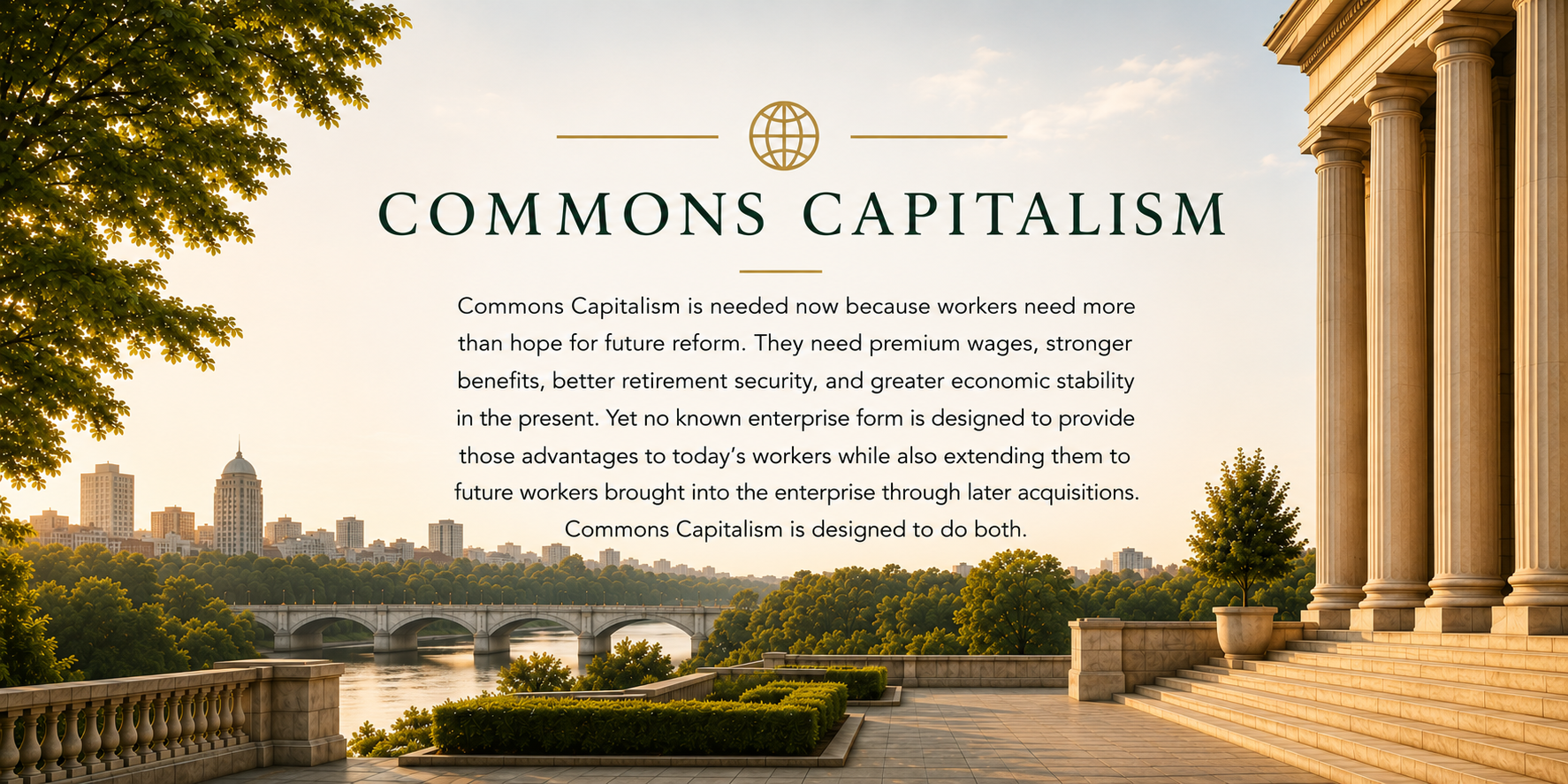
New to Commons Capitalism? The Introduction explains the basic concepts and distinctions needed to understand Commons Capitalism.
Explore Commons Capitalism
- Origin — How Commons Capitalism developed.
- Apologia— Why Commons Capitalism is worth examining.
- Introduction — A guide to understanding Commons Capitalism.
- CCE Formation — Organizational architecture.
- Commentary — Essays, applications, and responses.
- Forms — Drafting and implementation materials.
- CC Economics — Economic analysis
Latest Commentary
Latest Research
My latest research,“Commons Capitalism and the Institutional Economics of Worker Well-Being,” by Jonathan D. Cope, is available at SSRN and Zenodo
SSRN:
https://papers.ssrn.com/abstract=7591561
Zenodo:
https://zenodo.org/records/23310639
I’m currently finishing my fourth research paper, Commons Capitalism and the Worker-Capital Chasm, which examines how Commons Capitalism can reduce workers’ exposure to precarity and economic shocks by providing higher wages, funding stronger worker benefits and education, sustaining employment during downturns, and using institutional reserves to lessen the immediate impact of layoffs, income loss, and business instability.
On Deck, my fifth research paper: Commons Capitalism: Scaling Beyond Worker Cooperatives. Using Mondragón’s institutional services as a point of comparison, this paper examines how Commons Capitalism could overcome structural constraints on worker cooperative growth and advance worker well-being to tens of millions of workers. It explores how expanding enterprises and accumulated resources could support fair wages, improved benefits, employment stability, and institutional services addressing workers’ household precarity, with the potential to extend those services beyond what Mondragón currently provides.
Visit CC Economics for additional Commons Capitalism research
In Development
The CC Economics page has been reformatted to give readers a preview of the coming research topics on the legal, economic, and institutional architecture of the Commons Capitalism Entity
Forms: Articles of Incorporation for a Foundational CCE and Constitutional Documents for intergenerational stewardship of Surplus
Scope Of This Research
This research began with a practical inquiry into whether the structure of a business enterprise could be designed differently to improve working conditions and the economic position of workers. As that inquiry developed, the central purpose of the research became the examination of whether a different form of market enterprise can materially reduce worker precarity over the long term while helping create the economic conditions for constructive worker well-being within society. The research therefore considers not only the vulnerabilities workers face under conventional shareholder capitalism, but also structural limitations that can arise in worker cooperatives, employee ownership trusts, and other worker-oriented enterprise forms.
This work is being developed with a long horizon. Its purpose is to create a body of research that may allow researchers, economists, lawyers, and others sometime within the next twenty-five years to understand Commons Capitalism, evaluate its potential benefits, and examine the Commons Capitalism Entity as a workable alternative form of market enterprise. The objective is not to predict when or whether widespread adoption will occur, but to leave a sufficiently developed framework so that future researchers and practitioners will not have to begin with the underlying concept unexplored.
Commons Capitalism is conceived as a scalable institutional model rather than one confined to small enterprises or isolated experiments. If successfully developed, replicated, and adapted across industries and regions, CCEs could ultimately encompass millions, or even tens of millions, of workers while continuing to pursue the central objectives of reducing worker precarity and improving long-term worker well-being.
The development of Commons Capitalism began as an open-ended inquiry. As the structure has taken shape, however, the proper limits of this work have become clearer. My role is not to anticipate every economic, institutional, or social development that Commons Capitalism might eventually produce, but to develop the mechanism through which it can function, grow, and be tested. That realization has transformed the work into a substantially closed-ended undertaking. Although I can see possible developments extending far beyond any presently discernible economic horizon should Commons Capitalism become a significant or even dominant form of enterprise, those developments must arise from future structural evolution, practical experience, and the work of others.
To that end, I am now concentrating on a defined series of research papers addressing the principal legal, economic, financial, organizational, and worker-related features of Commons Capitalism. Those papers are being published through SSRN and Zenodo to establish a durable, publicly accessible, and independently preserved research record that can remain discoverable after my active development of the subject has ended.
That concentration on research also changed the form of the work. An earlier plan contemplated preparation of a comprehensive treatise on Commons Capitalism. Producing and maintaining a treatise would require substantial time while duplicating much of the analysis being developed more rigorously through the research papers. The treatise therefore gave way to a more focused objective: complete the principal research, preserve it in established scholarly repositories, and leave a coherent foundation from which future researchers can evaluate, test, criticize, refine, or develop Commons Capitalism and the CCE structure.
This research does not assume that Commons Capitalism should replace every form of capitalist or worker-owned enterprise. Some markets, enterprises, and circumstances may remain better suited to other structures. The narrower and more important inquiry is whether the CCE can provide a durable institutional means of reducing worker precarity, improving wages and benefits, strengthening employment security, supporting education and economic resilience, and contributing over time to broader worker well-being.
At that point, the research must yield to practice. The next stage, if it comes, will depend on the creation, operation, adaptation, and study of actual Commons Capitalism Entities. The research can establish the architecture; future use will determine what that architecture can become.
Lorem ipsum dolor sit amet, consectetur adipiscing elit. Ut elit tellus, luctus nec ullamcorper mattis, pulvinar dapibus leo.
The Going Wage Is Not Necessarily a Fair Wage